Reanimation package of reforms > News > Longreads > Ukraine’s Next Steps in the EU Integration: How to Overcome the Challenges of the Fundamental Negotiation Cluster?
The process of European integration is complex and challenging, especially in wartime. It can be confidently stated that Ukraine’s experience on its path to the EU is unique, both for the EU and for Ukraine itself. Since 2022, Ukraine has shown exceptional dynamism in integrating with the EU, sometimes setting records in the EU enlargement process. Ukraine and the EU officially began accession negotiations at the First Intergovernmental Conference in June 2024. A negotiation framework was also approved, which serves as the primary document outlining the principles of the negotiation process with the candidate country. As expected, the negotiation framework for Ukraine places even greater emphasis on the fundamental (reforms) cluster.
The updated EU enlargement methodology stipulates that negotiations on the fundamental reform cluster begin at the start of the negotiation process and remain open until its completion and the country’s accession to the EU. Thus, the reforms included in this cluster determine the overall dynamics of the negotiations, and their outcomes influence the implementation of other sectoral reforms.
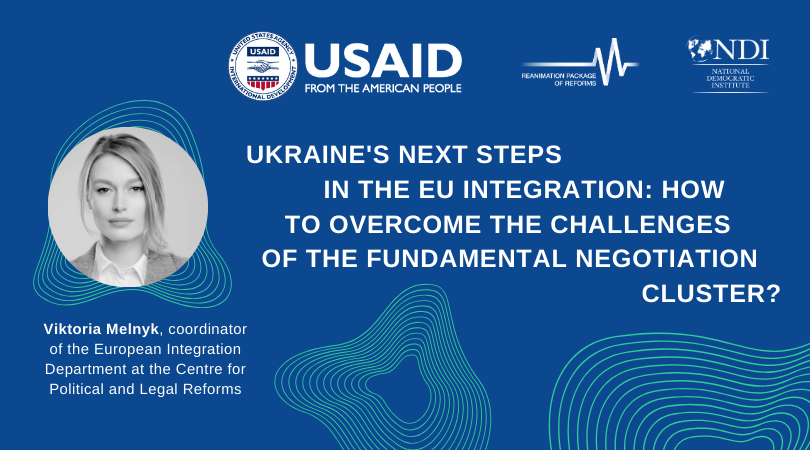
Viktoria Melnyk, coordinator of the European Integration Department at the Centre for Political and Legal Reforms (a member NGO of the RPR Coalition), explained more about the fundamental cluster and the challenges we need to overcome in fulfilling it specifically for the Reanimation Package of Reforms Coalition.
Currently, the fundamental reform cluster remains formally closed for negotiations, as Ukraine needs to meet the initial target indicators for its opening, namely, the preparation of three roadmaps and an action plan on national minorities.
Immediately after the conclusion of the first intergovernmental conference, the second stage of screening and preparation for bilateral meetings on each of the chapters effectively began. This stage is obviously more extensive and complex than the previous ones, as it involves a full compliance assessment and the preparation of a screening report based on the results of this assessment. The screening report is expected to be presented at the end of 2024. It will contain information on the state of alignment and the main gaps.
What sets this cluster apart from others is that these reforms are primarily based on international standards and are implemented in all countries with consideration of their legal systems. In contrast, other clusters are based on specific EU legal acts. Therefore, alignment will be determined not by assessing the implementation of EU legal acts but by evaluating the achievement of interim and final target indicators. The European Commission will develop these indicators following the screening and evaluation of the roadmaps. All member states will agree upon them.
The components of this cluster are among the most challenging for any candidate country, particularly the functioning of democratic institutions, public administration reform, justice, and anti-corruption reform. Ukraine is embarking on this path during wartime. It will clearly have to consider the challenges and impact of the war on democratic reforms. That’s why it is essential to understand that organizing and structuring the preparation process is crucial in achieving reform results and progress on the European integration path.
The aspects we will discuss further are not directly part of the reform tasks but are significant for ensuring synergy between all participants involved in the European integration processes.
Analytics and strategic vision are inseparable stages of policy analysis and formation, which are crucial in preparing a country for EU membership. Analytics and strategic vision are essential in the negotiation process regarding the fundamental reforms cluster. We need to focus on a deep analysis of the current situation to determine the legislative alignment needs and the scope of tasks that Ukraine will face at all stages of the negotiation process. Understanding the problems and gaps should become a resource for achieving reform results. This resource will help Ukraine formulate tasks to address issues, prioritize them, and establish timelines for implementation.
Monitoring should also be an essential component, allowing the assessment of task implementation status and the potential identification of shortcomings or the effectiveness of their implementation. It is necessary to ensure both internal government and independent monitoring by civil society. Such an approach will help create a comprehensive picture in addition to the assessment by the European Commission.
Thanks to a comprehensive approach combining these three elements, a candidate country can develop a detailed action plan to ensure effective negotiations and successful integration into the European community. Moreover, analytics will allow for the evaluation and forecasting of the potential social and economic consequences of EU membership. Often, obstacles to effective reform in Ukraine have been using chaotic decision-making models and patching up gaps. Therefore, a proper focus on analysis, forecasting, and monitoring will allow us to move away from such approaches in implementing decisions.
Communication, coordination, and building partnerships. Significant dynamics have also marked the opening of Ukraine’s EU accession negotiations in preparation for the following stages. However, with increased dynamism, it is essential to consider the risks of chaotic interaction among stakeholders. It is crucial to establish vertical and horizontal communication and coordination to prevent such situations. In the context of the negotiation process, building an institutional structure that ensures effective decision-making and institutional memory retention is critically important. At the same time, coordination among participants who support the government in the negotiation process, including international technical assistance projects and civil society organizations, is relevant. Such coordination is essential for forming common positions and preventing duplication in providing technical assistance. Additionally, interaction in the context of formulating policy recommendations will only enrich and bring all participants closer to achieving results.
It is also worth noting that the volume of tasks facing Ukraine is significant and requires expertise in various fields. Building partnerships can be the key to the success of Ukraine’s EU accession negotiations. Uniting the efforts and capabilities of civil society organizations within the country will allow for more excellent coverage of EU integration tasks. At the same time, the most pressing issue is building partnerships with think tanks in other candidates and member countries. Cooperation between Ukrainian think tanks and those in candidate countries is an effective tool for finding standard solutions to the challenges of the EU enlargement process and avoiding artificial competition on the path to the EU. Additionally, work within the EU remains relevant to ensure continued support for Ukraine. In this context, joint efforts between Ukrainian and European think tanks will strengthen support for Ukraine and facilitate the exchange of experience among them.
Information, Education, and Capacity Building. In numerous communications with representatives of European institutions and think tanks, we often hear questions about plans for managing citizens’ expectations during Ukraine’s EU accession negotiations. This issue is relevant for both the government and civil society. Gaining candidate status and opening the negotiation process were essential and inspiring events for citizens. However, the more technical nature of the negotiation process and the alignment of Ukraine’s legislation will require more work to communicate with the public. Therefore, it is crucial to change the approaches to informing citizens about Ukraine’s path to the EU, particularly regarding the stages of the negotiation process, task completion, and the impact of decisions on citizens.
Moreover, such educational activities will allow citizens to become interested and engaged in European integration processes as proactive participants in change. In the long term, this work will be critical to more active citizen participation in decision-making processes at all levels. It will lead to an increase in political culture.
The European integration processes require the development of new competencies at both the civil service and civil society levels, and the deepening of the negotiation process demonstrates the need for capacity building. There is a significant demand for deepening knowledge about the specifics of the EU accession process and the future functioning of Ukraine as a full-fledged EU member. Understanding that most changes and reforms will be inextricably linked to the negotiation process is essential. Building capacity and acquiring new knowledge is necessary to participate effectively in European integration processes.
Focusing on three key components is essential to achieve sustainable capacity-building results. Systematic training involving civil servants and civil society representatives should correspond to the needs of the negotiation process, and a mixed audience will allow for additional results in building effective dialogue. A separate emphasis should be made on restructuring educational programs in universities to prepare future specialists with the necessary knowledge and competencies. The third important aspect is the exchange of experience, which can provide practical knowledge about the negotiation process. Such exchanges can be internal (among colleagues) and external, involving experts from member states and other candidate countries.
Ukraine’s integration into the EU is a goal and a multifaceted process that requires understanding and joint efforts. Despite significant achievements, Ukraine faces several challenges related to reforming key sectors. The opening of EU accession negotiations marks a new stage in this journey, requiring maximum stakeholder mobilization. The success of European integration depends on the effective coordination of actions by government agencies, businesses, and civil society, as well as international support.
This publication was prepared by the Reanimation Package of Reforms Coalition with the generous support of the American people through the United States Agency for International Development (USAID) under the Ukraine Responsible and Accountable Politics Program (U-RAP), implemented by the National Democratic Institute (NDI), International Republican Institute (IRI), and International Foundation for Electoral Systems (IFES). The opinions expressed in this publication are those of the experts and do not necessarily reflect the views of the United States Agency for International Development (USAID) or the United States Government.


