Reanimation package of reforms > News > Analytics > Ukraine’s EU Integration in the First Half of 2026: Between Risks and Opportunities
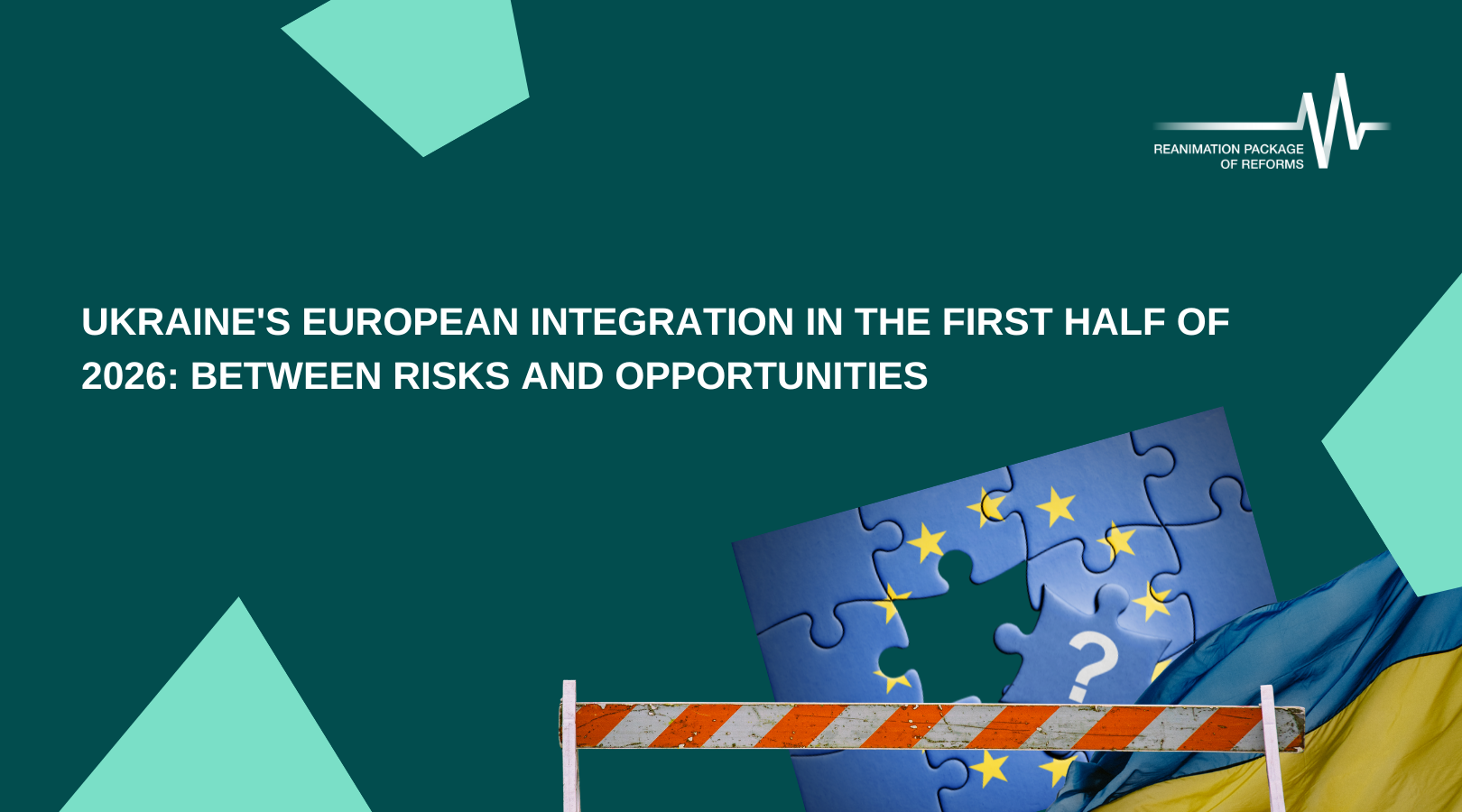
Despite the European Union’s strategic support for Ukraine, the first half of 2026 brings both new opportunities for integration and serious risks. On the one hand, there is political fatigue, internal institutional exhaustion, and the threat of blockages by individual member states. On the other hand, there is the increasingly active implementation of a model of gradual integration, a rethinking of EU rules, and the strengthening of Ukraine’s role as a security actor.
The Ukrainian Centre for European Policy (UCEP) has analyzed the key challenges and opportunities for Ukraine in the first half of 2026.
The risk of EU “financial complacency.” After the adoption of a large credit package for 2026–2027, there is a temptation within the EU to consider the “Ukrainian issue” temporarily resolved. This is dangerous for Ukraine, as political attention may shift away from negotiation clusters toward other crises, and the opening of clusters may once again be postponed under slogans such as “stabilisation first” or “internal unity.”
The risk of blockages and “vetocracy.” Hungary (and potentially several other states) will continue to use unanimity as a bargaining tool—not only on financial issues, but also on EU integration procedures. This puts Ukraine back on familiar ground: even technical decisions can become politicised, and the opening of negotiation clusters may be tied to external conditions unrelated to Ukraine’s reform progress. As a result, decisions may once again be postponed until “after the summer,” without clear dates or criteria. At the same time, Viktor Orbán faces difficult elections in April, which could potentially lead to a more favourable context for Ukraine.
Ukraine’s internal risk: institutional exhaustion. The first half of 2026 marks the fourth year of full-scale war. Even with sustained political will, the resources of the state apparatus are limited. The European Commission is increasingly focusing not on legislation, but on implementation capacity, and weaknesses in public administration and anti-corruption efforts quickly become arguments for sceptics within the EU.
A window of opportunity for gradual integration. The EU is increasingly applying a model of phased integration of Ukraine into EU policies and markets (with roaming being only the first step). In practice, this already provides Ukraine with real integration before formal membership. For Ukraine’s advocates, this is a strong argument that the country is already a de facto part of the EU. The next successful cases could include integration into the internal market (digital and energy) and participation in EU programmes under conditions close to those of member states.
Relaunching the debate on internal EU reform. The failure to reach a decision on the use of frozen Russian assets has become a wake-up call for Europeans themselves. Ukraine has become a case through which the EU is rethinking unanimity, veto power, and institutional effectiveness. Enlargement is increasingly viewed as a security issue rather than a purely technical one. This signals a growing willingness to discuss qualified majority voting in non-sensitive areas and to search for effective workarounds to overcome blockages.
Rethinking Ukraine’s role in Europe’s security architecture. In 2026, the nexus of “security–enlargement–Ukraine” becomes increasingly tight. Ukraine is no longer perceived as a “candidate asking for membership,” but as a contributor to European security. This shifts the tone of negotiations—from conditionality to strategic partnership—and makes it harder for Eurosceptics to politically justify prolonged delays in the process.
The first half of 2026 will be a period of struggle between inertia and political decision-making. If the EU opts for excessive caution, Ukraine’s EU integration risks slowing down once again. If Ukraine succeeds in combining reforms, diplomatic pressure, and a security-based logic, there is a real chance to move the process from promises to an irreversible phase of concrete actions and genuine negotiations.


