More than 50 representatives of the government, parliament, civil society and expert community discussed the key priorities of Ukraine’s accession to the EU during the forum “Through Reforms to the Stars: Parliament, Government and Civil Society” on May 22, 2024.
The event began with an address by the Chairman of the Verkhovna Rada of Ukraine Ruslan Stefanchuk: “This forum is a platform where the government, civil society and our international partners can discuss what achievements and further tasks Ukraine is approaching the negotiation process with.”
Ms. Katarina Mathernova, Ambassador of the European Union to Ukraine, also emphasized the importance of dialogue: “The strength of civil society is the basis for sustainability. We support you financially as well as politically. And the dialogue between the legislative branch, between the government and the EU will become even more important when the negotiations are open.”
Yulia Kyrychenko, Co-Chair of the RPR Coalition Board, member of the Board of the Center for Political and Legal Reforms, agrees: “We understand our responsibility during a full-scale invasion, and we want to be a reliable partner for the Ukrainian authorities so that we can start this process as soon as possible and cope with the harmonization of legislation as quickly as possible.”
“It is important for us that Ukraine wins on the battlefield. And one of those battlefields is the battlefield of ideas. These are European values, which are the antithesis of a totalitarian regime. The great ambitions of Ukraine and what it is doing to join the European Union are also part of this victory, especially in the cluster of fundamental rights,” said Paul Zubkov, Head of European Projects at DRI.
The experts then moved on to discuss the negotiation process with the EU. Wolfgang Nozar, Head of the Division for Fundamentals, Rule of Law, Anti-Fraud and Financial Management at the Directorate-General for Neighborhood Policy and Enlargement Negotiations (Ukrainian Section), emphasized: the EU expects that the reforms will continue to be implemented with enthusiasm. He explained that the launch of negotiations and the opening of the Fundamental Cluster is rather a technical process, so the key driver will be Ukraine’s reforms.
The Fundamental Cluster is the first to be opened for negotiations and the last to be closed. It reflects the principles on which the EU is based: democracy, rule of law, human rights, economy and competitive market, stability and prosperity. It includes five negotiating chapters as well as the Copenhagen criteria. The peculiarity of most of the cluster’s components (including political and legal reforms) is the absence of specific acts of EU law that could be used to approximate Ukrainian legislation.
Deputy Prime Minister for European and Euro-Atlantic Integration Olha Stefanishyna emphasized: “Our negotiation process will include representatives of civil society and business. This will be a decision officially approved by the Government. I think this is a very important element not just of European integration, but of reconciliation. In Ukraine, civil society is in some way opposed to the government, and the government to civil society. Today, this process is changing. And for me, the appropriate solution is global reconciliation and a global path. For me, the negotiation process on joining the EU is first and foremost a joint effort that gives us confidence in our future.”
“We have conducted our own screening procedure, which allowed us to identify the scope of work that awaits us and the key responsible persons. We have come a long way in meeting the requirements of the European Commission, some of which also applied to the fundamental cluster. We have come a long way, but of course, there is still a lot to do,” – Oleksandr Ilkov, Director General of the Government Office for Coordination of European and Euro-Atlantic Integration, described Ukraine’s path to starting work with the fundamental cluster.
In order to start this dialogue now, the forum participants then presented and discussed their vision of working with the Pillar in various areas.
Rule of law and democratic institutions
During the first panel, experts and government officials discussed the rule of law and democratic institutions. Denys Maslov, Chairman of the Verkhovna Rada Committee on Legal Policy, emphasized that Ukraine has already passed important bills in this area: “Now I would like us to focus on their implementation, procedures, and monitoring. It’s good to get a “green tick”, but we must not forget about its subsequent implementation.”
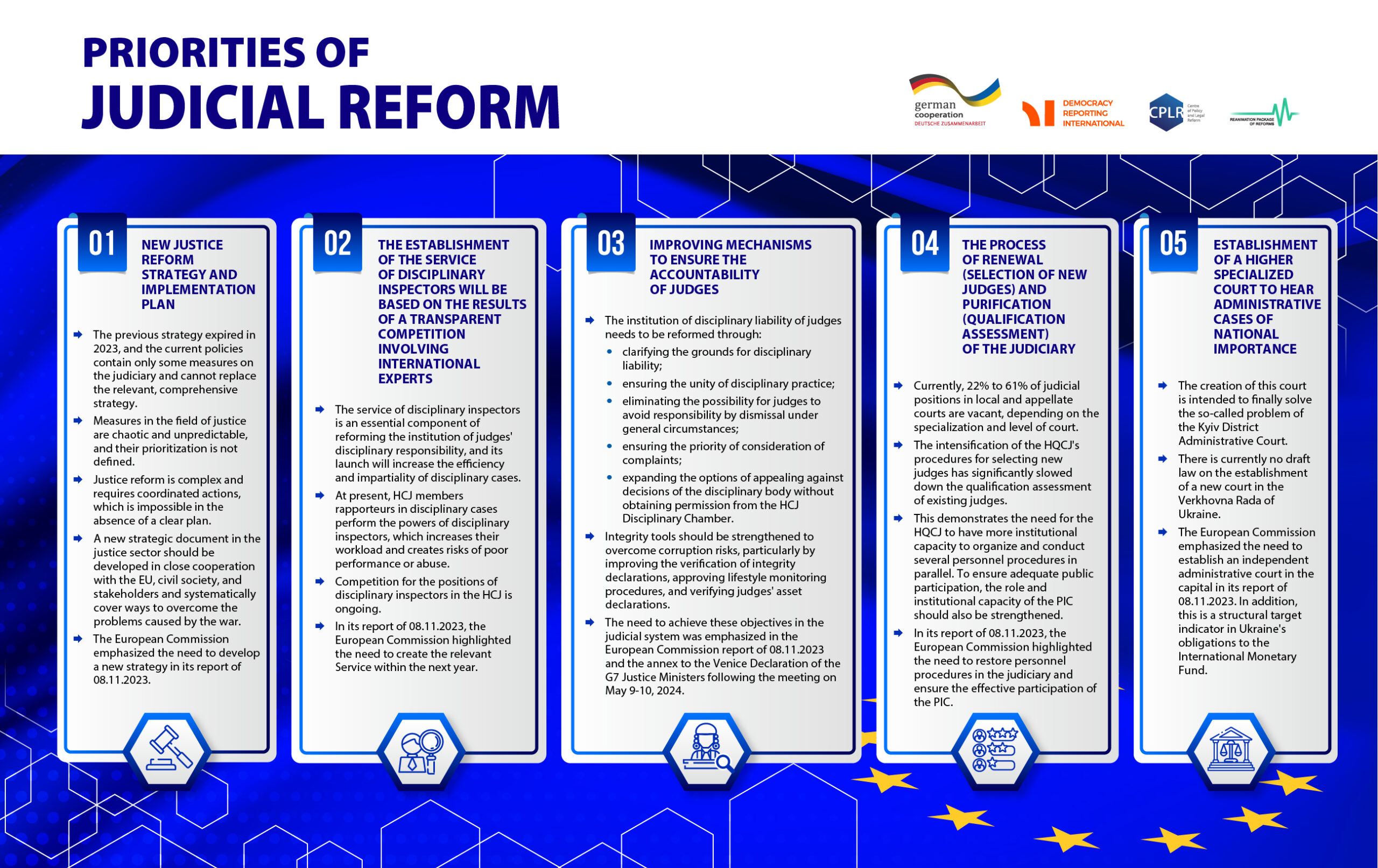
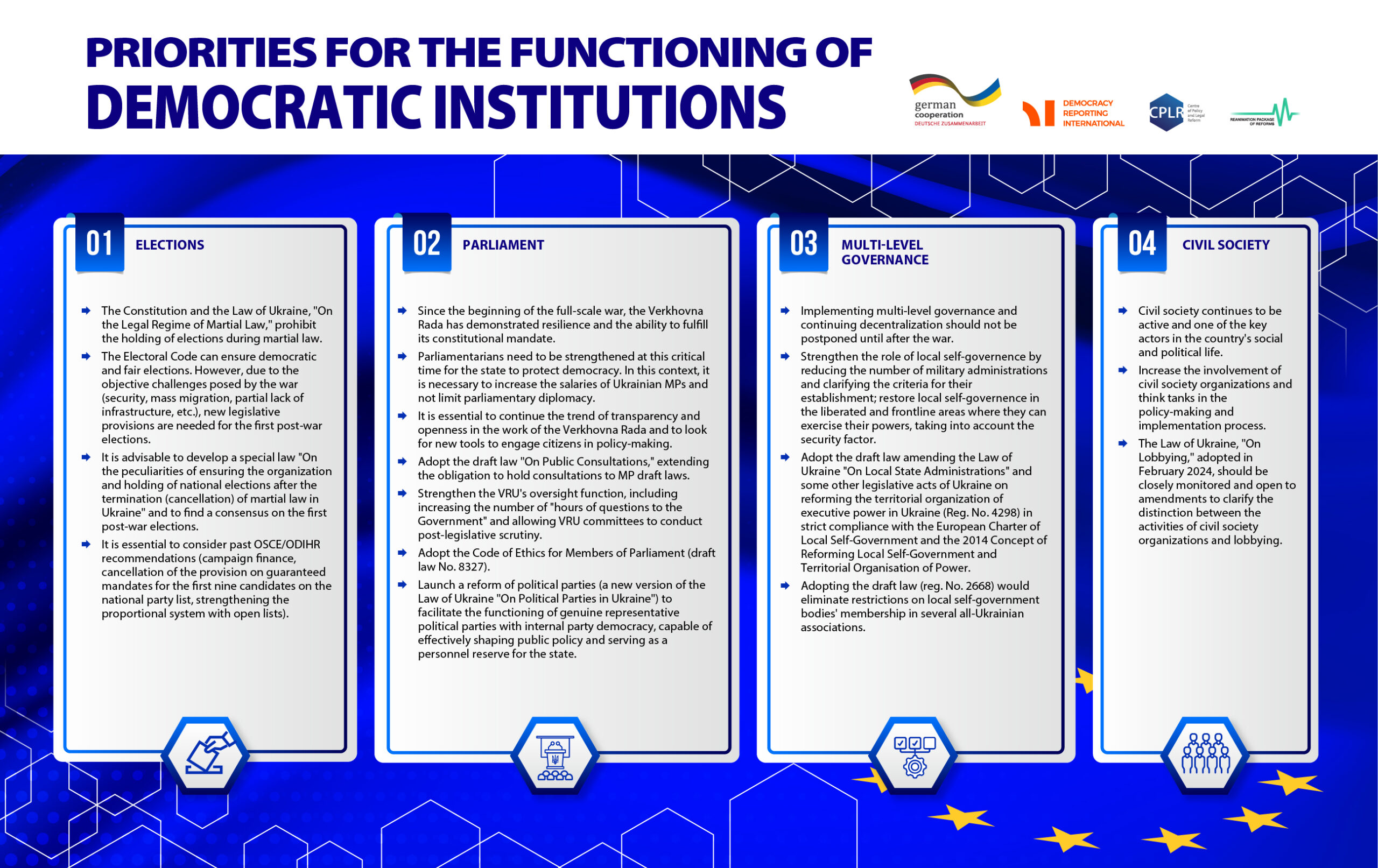
Experts from the Centre of Policy and Legal Reform presented the priorities of judicial reform, law enforcement reform and the functioning of democratic institutions.
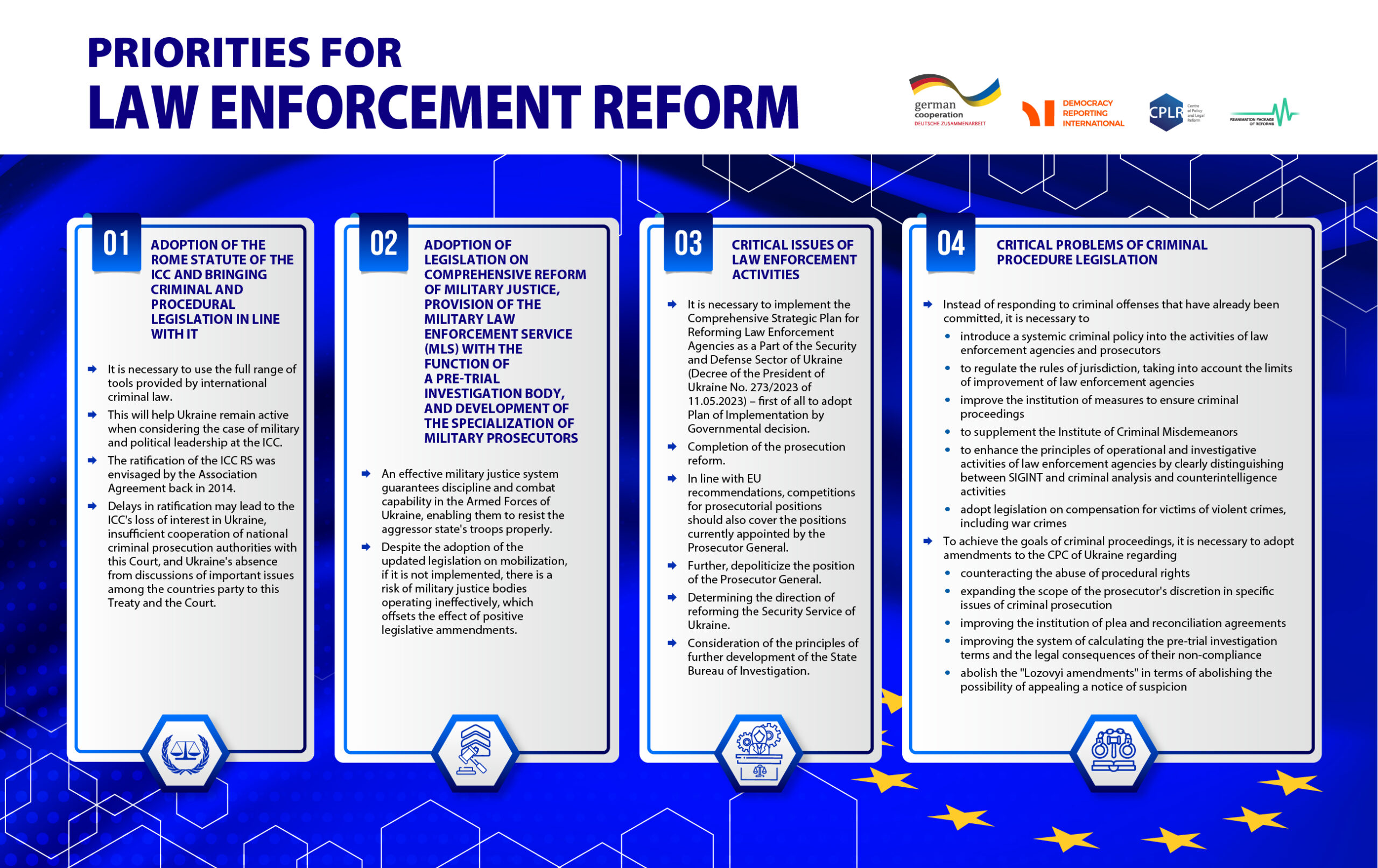
Yevhen Krapyvin, criminal justice expert at the Center of Policy and Legal Reform, reminded that Ukraine has two key priorities in the context of war: “This is the issue of military justice, for example, the adoption of the Rome Statute is critical. And also, in general, the issue of building up bodies that investigate crimes.The other side is what concerns military justice. That is, the bodies that investigate violations in the armed forces.”
Effective public administration
The experts then moved on to reforming the state apparatus. Olena Shulyak, Head of the Verkhovna Rada Committee on Organization of State Government, Local Self-Government, Regional Development and Urban Planning, emphasized: “Our challenge is public administration reform, which began in 2016. The Committee is working on it, of course, many things still need to be done.”
We presented our vision of public administration reform.
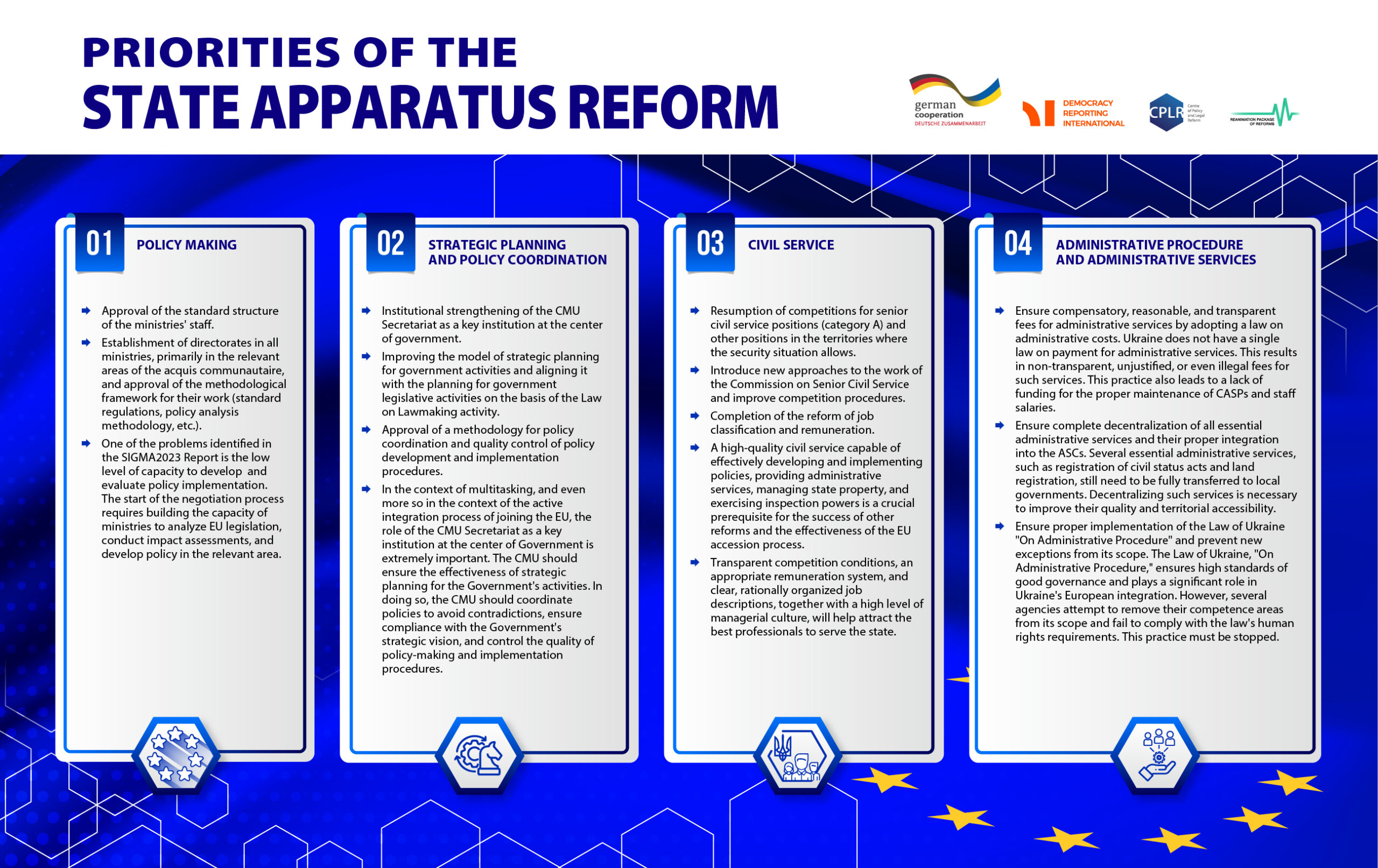
Chairman of the Board of the Center of Policy and Legal Reform Ihor Koliushko summarized: “The efficiency of public administration organization is one of the key factors for joining the EU. If we are not able to create an effective public administration, it is better not to join the EU, because we will not feel comfortable there.”
A capable economy
The forum was concluded with a panel on the capable economy. Taras Kachka, Deputy Minister of Economy of Ukraine, emphasized: “The European Union is a key market for us… For us, the EU is not a new universe, but a practical partner.”
In his presentation, EasyBusiness CEO Dmytro Lyvch described how Ukraine is closely integrated into the European economic system: 60% of exports are currently going to the EU, and more than half of imports are also from there.
“The entire narrative of Ukraine’s recovery and development can be built on the example of international experience: the transition from direct aid, from trade preferences to private sector development through direct investment. But this is impossible without structural economic reforms,” – Dmytro Lyvch summarized.
Through reforms to the stars
Finally, Olga Lymar, Executive Director of the RPR Coalition, summarized the results: “The key conclusion is the importance of cooperation between all stakeholders, we have no other choice, especially during a full-scale war. Civil society has matured, the challenges are becoming more serious and the responsibility is growing. Therefore, we must find ways to cooperate effectively.”
The event was held within the framework of the Democratic Integration, Resilience and Engagement (Ukraine-DARE) project, implemented by Democracy Reporting International (DRI) with the financial support of the Federal Foreign Office of Germany and in cooperation with the Reanimation Package of Reforms Coalition and the Centre of Policy and Legal Reform.The opinions and views expressed during the event do not necessarily reflect the position of the Federal Foreign Office of Germany.


