Reanimation package of reforms > News > The Role of Civil Society in Negotiations on the Fundamental Reform Cluster
In November 2024, Ukraine and the EU completed bilateral meetings on the first—fundamental—block of the negotiation process. Soon, we expect the opening of negotiations on the relevant chapters.
A crucial element for the start of negotiations will be roadmaps for reforms in the areas of the rule of law and public administration, as well as the strengthening of democratic institutions.
What are the strategic priorities of these roadmaps? What steps must we take toward their implementation? And what challenges will Ukraine face in this process?
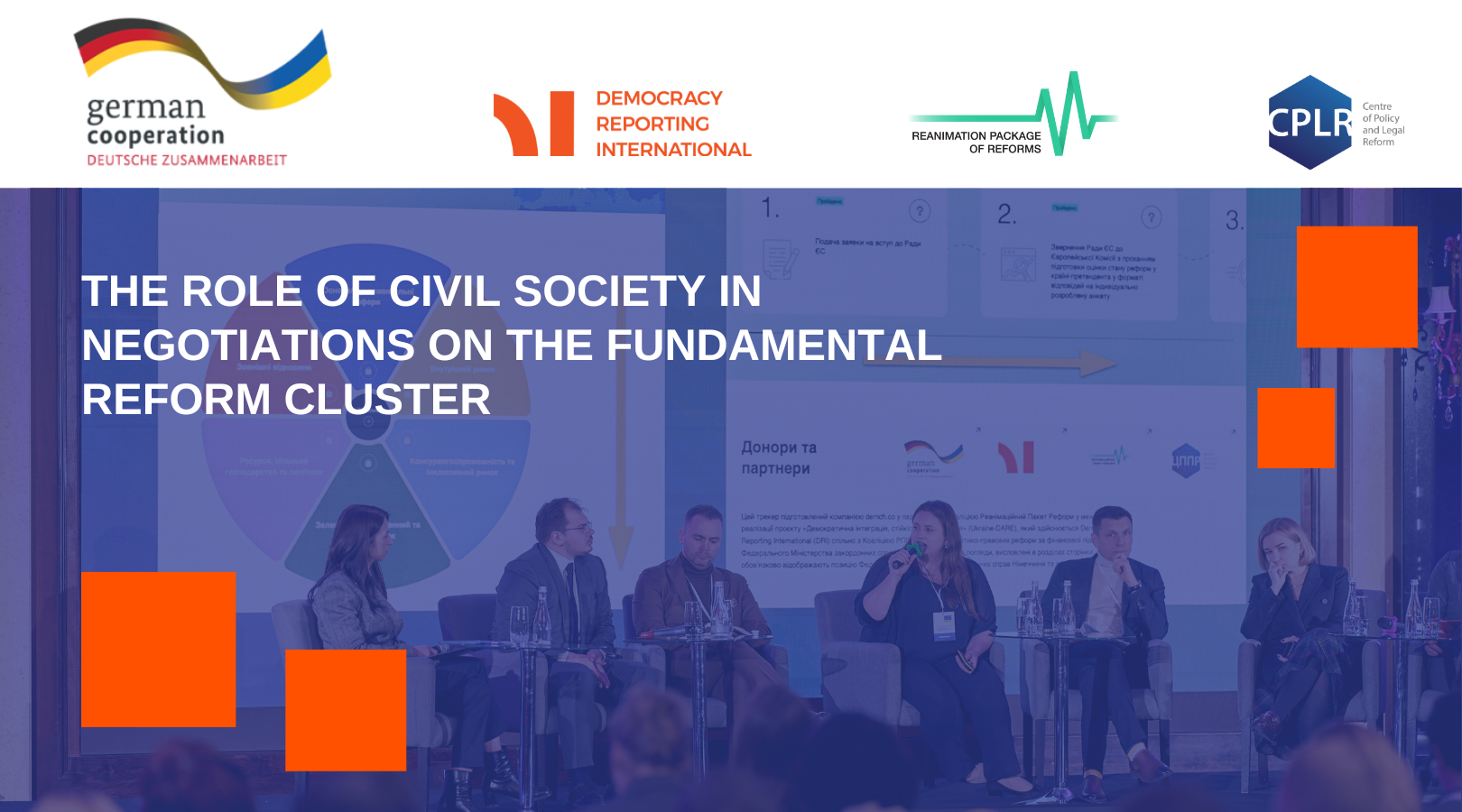
Representatives of the Government, Parliament, the European Commission, the expert community, and civil society discussed all these issues at the Forum “Ukraine’s Accession to the EU: Shaping the Transformational Agenda,” jointly organized by the Office of the Deputy Prime Minister for European and Euro-Atlantic Integration of Ukraine and the Ministry of Justice of Ukraine.
One of the participants was Olga Lymar, Executive Director of the RPR Coalition. Below, we publish key points from her speech.
The Reanimation Package of Reforms (RPR) Coalition unites many organizations with different perspectives and priorities. It is a unique example of how civil society can be effective even amidst diverse opinions. Given your experience, how can common positions be found and an effective dialogue established with the authorities and society to advance European integration reforms?
To put it briefly—by being responsible. We understand that the primary responsibility for Ukraine’s successful integration into the EU lies with the state, primarily with the Government and Parliament. At the same time, the whole society is undergoing integration, meaning that we will all face the consequences of successful or unsuccessful European integration.
Over the past few weeks, reading the news daily, I keep wanting to ask: “Who is left to be an adult in this world?” As a state, as a society, and especially as representatives of civil society, we cannot afford to be infantile.
I believe that others will talk about the responsibility of the authorities—that is clear. Instead, I will talk about the responsibility of civil society. Because civil society, as the proactive part of society, must recognize its unique responsibility.
First and foremost, for the quality, balance, and consolidation of the positions and recommendations we promote, including as members of working (negotiation) groups. It is a useful exercise to put ourselves in the shoes of decision-makers and understand that recommendations must not only be correct and beneficial but also reconcile the positions of various stakeholders, including businesses.
Second, we must take responsibility for the consequences of our advocacy methods and understand when the goal does not justify the means. A willingness to cooperate with the authorities does not mean “not being critical.” Likewise, being critical does not mean being irresponsible.
Third, as a representative of the most stable coalition of leading civil society organizations, which celebrated its tenth anniversary last year, I fully realize how difficult it can be to find a common position. At the same time, I know for sure that a shared position has a significantly greater advocacy impact and is more likely to be openly accepted by society.
I believe that Ukrainian civil society is involved in the implementation of all reforms, at the very least because they emerged as a result of the window of opportunity for change following the Revolution of Dignity. In the context of the war, it is important to mention decentralization reform. It is considered one of the most successful reforms, despite the fact that several steps still need to be implemented. Moreover, we have seen how, in the first year of the full-scale invasion, communities demonstrated greater resilience in resisting Russian aggression and coping with war-related challenges, partly thanks to decentralization reform.
Most reforms, or steps in their implementation, are linked to the European integration process. Consider the media reform: the adoption of the Media Law was one of the seven recommendations of the European Commission for launching negotiations.
I would like to focus on a reform in which civil society has been less involved and which has received less attention—the cornerstone of all reforms—public administration reform. Civil society is a partner of the state, but we are not a substitute for it. We are aware that political changes, not only in Ukraine, create turbulence for civil society organizations. However, we cannot allow instability within the state itself. That is why our efforts must also be directed toward strengthening the institutional capacity of government bodies.
Finally, we are also responsible for explaining the European integration process, its challenges, and its consequences to society. Currently, EU accession is perceived by society as “all good versus all bad.” In many ways, this is true. For Ukraine, it is certainly an existential choice. However, explaining how the negotiation process works, how positions are formed, and what implications this will have for every citizen is essential to minimizing any rollback in the unprecedented public support for European integration.
That is why the RPR Coalition, together with the Center for Political and Legal Reforms and DRI, developed the European Integration Tracker, which does not duplicate but rather complements the awareness-raising efforts of the European Integration Office. We will highlight key steps in the negotiation process and supplement official documents with analyses from civil society representatives.
The reforms initiated since the Revolution of Dignity in Ukraine are not just a set of technical components. They represent an existential choice for an independent, European, and democratic Ukraine. This may explain the strong interest of civil society in developing the Roadmap for the Functioning of Democratic Institutions. Our European integration is taking place amid the challenges of a full-scale war. Moreover, let’s be honest—it is happening in the context of global challenges to democracy. And we must take this into account. That is why, in November last year, the RPR Coalition, together with the Center of Policy and Legal Reforms, DRI, and several other partners, organized the third “Democracy During War” Forum. This event became the first and unique platform for discussing these issues with parliamentarians, government representatives, international partners, civil society, the cultural community, and the military.
In conclusion, we have faced difficult negotiations at every stage of European integration. Just consider the challenges surrounding the lobbying law. However, I would like to sincerely thank Olha Stefanishyna and her team for their openness to dialogue and willingness to listen to one another. European integration is not only an opportunity to transform the state but also to strengthen civil society, enhance our expertise, and improve our advocacy methods.
Our European integration is about preserving and strengthening democracy. And this is precisely the area where the role of civil society will remain crucial.
The key points from the speech at the Forum “Ukraine’s Accession to the EU: Shaping the Transformational Agenda” are published as part of the “Democratic Integration, Resilience, and Engagement” (Ukraine-DARE) project, implemented by Democracy Reporting International (DRI) in cooperation with the Reanimation Package of Reforms Coalition and the Center of Politicy and Legal Reforms, with financial support from the German Federal Foreign Office. The project aims to align Ukrainian legislation with EU norms, foster dialogue on the challenges to democracy in Ukraine during the war, and promote youth civic engagement. The opinions and views expressed in this material do not necessarily reflect the position of the German Federal Foreign Office.


