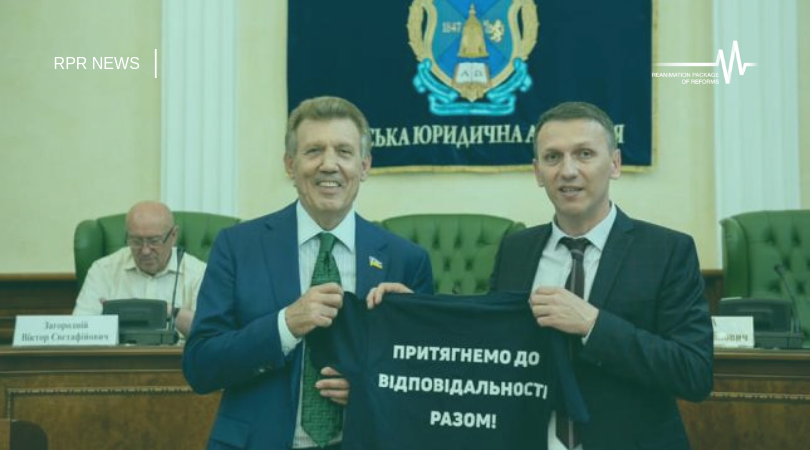
The State Bureau of Investigations has been fully operational for more than six months.
To recap, this law enforcement agency has inherited the jurisdiction of the General Prosecutor’s Office, including the jurisdiction over the crimes of high-ranking officials, judges, prosecutors, law enforcement officers, as well as military officers. A powerful law enforcement “monster” may even prosecute the leadership of the National Anti-Corruption Bureau and the Specialized Anti-Corruption Prosecutor’s Office. In other words, control over the SBI in the wrong malicious political hands can highly complicate life for both politicians and anti-corruption bodies. However, it has not done that so far, mainly due to the ineffective management of this institution.
The springboard for its ineffectiveness was laid down back during the adoption of the special law on the SBI. First, the experts, along with international experts, had another concept of the establishment of a law enforcement authority, but after amendments had been introduced by the MPs, there were some vivid distortions in it. In a diligent pursuit of trying to bleed dry the law, parliamentarians even “lost” the ability to recruit operational staff and skipped a few more important points. Secondly, the SBI managers were selected in the worst post-Soviet traditions – no representative of the public or international experts. People delegated to the commission were political appointees – three from the government, three from the parliament and three from the president of Ukraine. Thirdly, the transfer of cases that had been considered by the General Prosecutor’s Office before was ill-thought-out, which made it impossible to promote them normally and to bring the perpetrators to criminal responsibility.
Law enforcement cacophony – this is how the current situation in the SBI can be described. Director Roman Truba failed to get on with his deputies, Olha Varchenko and Oleksandr Buriak, from day one. Both parties are struggling to keep the opportunities provided by the law in every possible way. Sometimes, frankly speaking, they interfere with the responsibility of their opponents. The fake notes of the quasi-collegiate orchestra entitled the SBI are like nails on a chalkboard. However, it is important to understand the most important cause of the problems – these local wars were a direct consequence of the political agreements between the Petro Poroshenko Bloc and the People’s Front, which in fact controlled the “external” commission that selected the top management of the SBI. Different pressure groups from these politicians were doing their best to get their appointees in. And then, when the paths diverged, they left them with devastating incompatibility. That was the key reason behind all the local battles that the Bureau faced during its operation. And, given the recent trends in the consolidation of power in the hands of Roman Truba, we will recap on seven false notes that were heard from him as the lead musician in this trio.
1) Establishment of the first Public Control Council under the SBI — one of the key mistakes made by Roman Truba. In December 2017, immediately after he was elected as a director, representatives of the public and MP Mustafa Naiiem met with the head of the Bureau. We then explained that the establishment of the PCC under the SBI should take place solely through online voting, which the director agreed to. Subsequently, we learned that the establishment method would be old – through the constituent assembly – and, as a consequence, we have a completely inefficient Council. As a result, the SBI leadership ended up with a permanent ally-rival in political wars rather than a consultative and advisory body that would help it.
2) Political games around the appointment of 27 middle-level managers in the summer-autumn 2018.. To recap, back then, Roman Truba, in fact, slowed down the launch of the Bureau and blocked the appointment of the competition winners chosen by the “external” commission. The reason behind was not to get honest and professional subordinates, on the contrary, it was completely different: he wanted to have controllable people at hand, people he could trust. These words the author of the material heard in response to the questions posed to the SBI head back in October 2018. Subsequently, as expected, Roman Truba appointed 23 out of 27 candidates, and four positions are still vacant with employees close to the director acting in lieu of them.
3) Building a control system over the SBI by conferring illegal functions on the patronage service. In fact, Roman Truba created his own “authority hierarchy” managing territorial departments through the head of the aforementioned service Oleksandr Udovychenko. The facts of pressure on the part of the latter are reported by ordinary employees in the central apparatus, as well as heads of separate territorial departments. For example, it is documented in an official appeal signed by Udovychenko when he calls for criminal proceeding materials from the territorial department located in Mykolaiv.
4) Illegal dismissal of subordinates without the consent of the deputies as expressly required by the relevant law, and the avoidance of a regulatory requirement for the dismissal application from the “external” commission In this way seven middle-level managers were dismissed. Some of them have already challenged a sole and obviously illegal decision by director Roman Truba. The court sustained the claim and reinstated the complainants in office expressly forbidding the head of the Bureau to commit such acts. The legal basis for dismissal is frail – failure to pass the probationary period. The actual reason is quite simple – the subordinates did not want to become part of the Trubals “team”, which Truba regarded as support for the deputy director Olha Varchenko.
5) An attempt to monopolize power in the SBI through re-subordination of the investigating departments of the central apparatus of the Bureau. Let us remind you that this law enforcement body is quasi-collegial. This means not only that decisions are made by agreement, but also that each of the three SBI heads has its own area of activity. Director is a kind of top manager of the Bureau, the first deputy is responsible for the investigation, the second deputy is responsible for the commercial and administrative parts. Meanwhile, Roman Truba decided to change the procedure of work with two orders contrary to the law, and got control over investigating departments 1 and 2 of the central apparatus. In addition, through the head of his patronage service – the former prosecutor Oleksandr Udovychenko – he controls the vast majority of territorial departments. And those who disagree with the management are dismissed one by one. For example, such a fate befell the head of the territorial department in Poltava Volodymyr Tymoshko.
6) Attempts to interfere with bringing the head of the SBI patronage service Oleksandr Udovychenko to responsibility for absenteeism. The situation was as follows. The head of patronage service submitted a one-day leave request on April 26. Back then, the Bureau director was in the city of Lviv. Udovychenko did not come to the office on May 2-3, which was officially documented by the head of the Internal Control Office Bohdan Chobitok. The latter reported this to Roman Truba for the appropriate decision to be made. However, the SBI director did not bring his assistant to responsibility, instead he made changes from the next order to the previous one – based on Udovychenko’s written request – and granted that leave for May 2-3. It all happened in the retrospectively. Instead the SBI director dismissed Chobitok by a respective order.
7) Formation of controlled competition commissions which should appoint “suitable” candidates. A few months ago, it was said that the competition commission No. 2, controlled by Roman Truba, had held a non-transparent process for the selection of investigators. Then they mentioned the role of Oleh Shram, but now he himself admitted: lists had been given to him by Roman Truba through the “patronage” head Oleksandr Udovychenko. A similar trick with commission No. 1 failed, so the author of this text was kicked off the commission and they created an “internal competition commission” with Udovychenko in its composition.
In addition to the aforementioned seven “false notes” of Roman Truba, there are a few concerns that we cannot but mention. First, there is still a risk of lustration in relation to the SBI director. In other words, he, in fact, fell under the lustration ban, but astonishingly avoided it. Since a mere 9 people fell under such a ban, the lustration can fall on Roman Mykhailovych only if the law of universal legal gravitation, the center of which is located on Bankova Street, operates. Another case is the appeal against the appointment because Truba did not first file an application for the position of director during the competition.
P. S. The day before the publication, I had to meet with the abovementioned head of the SBI’s patronage service, Oleksandr Udovychenko who was to explain the entire list of events. The meeting, which he himself proposed, failed to take place.


