Reanimation package of reforms > News > Events > From Protests to Reforms: How Youth Is Transforming Civil Society in Ukraine
Ukrainian civil society was born out of protests.
The Revolution of Dignity, the Orange Revolution, the Revolution on Granite — most representatives of active civil society in Ukraine emerged from these movements. Yet today, civil society is undergoing a transformation, and the driving force behind this change must, first and foremost, be the youth.
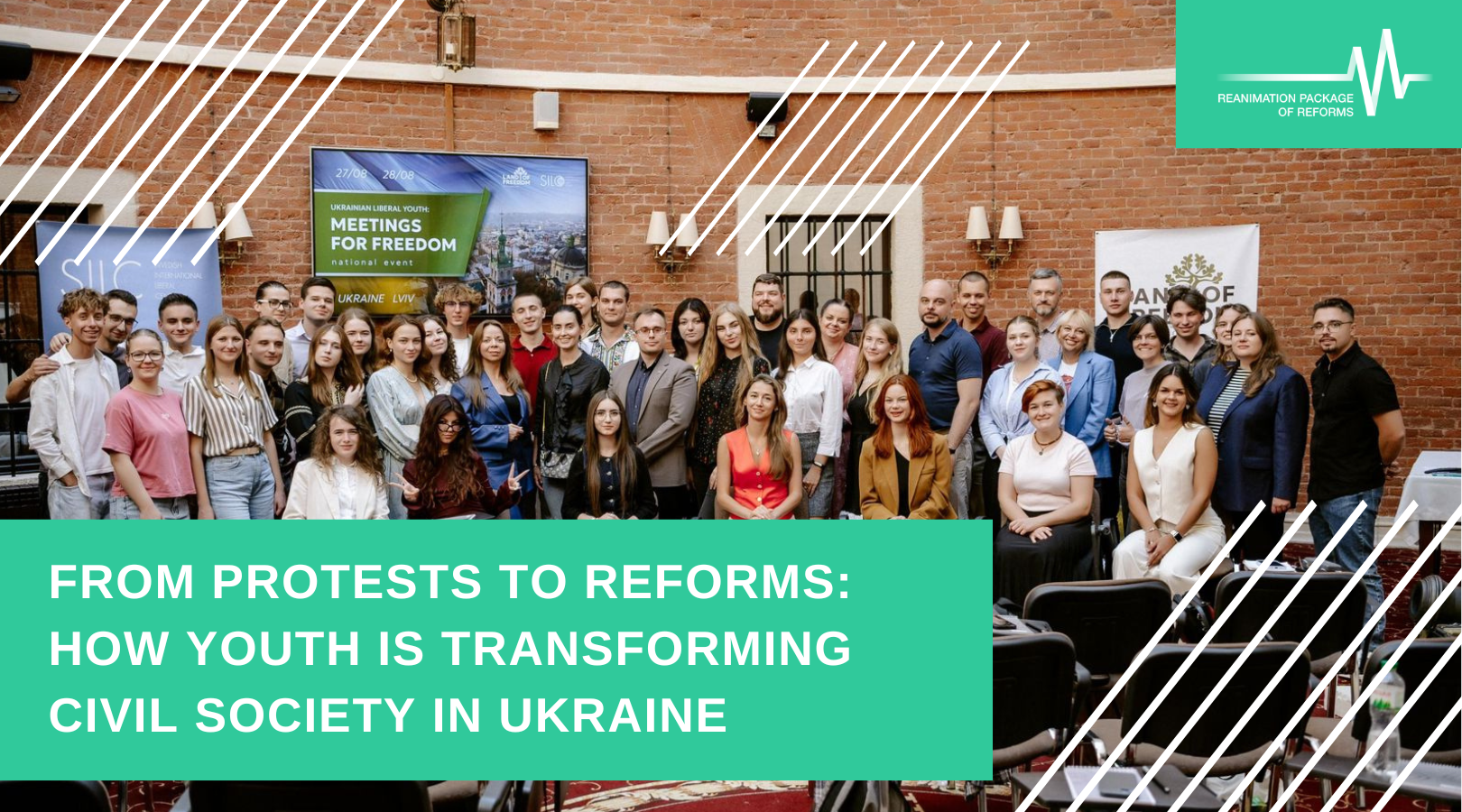
Last week in Lviv, the national gathering Meetings for Freedom brought together proactive young people from different regions of Ukraine to discuss, alongside leading political and civic figures, key domestic and international processes amid the challenges of war. The Reanimation Package of Reforms Coalition (RPR) team also took part in the discussion.
“Civil society in Ukraine is very unusual. My international partners constantly confirm this to me. Here it has not only produced an entire generation of politicians, but often takes on whole layers of work — from drafting legislation to advocating for its adoption. But it is important to remember: we are not replacing the state, we are helping it,” emphasized Olga Lymar, Executive Director of the Coalition.
The conversation also turned to Ukraine’s European integration. After all, accession to the European Union is not only about the economy or legislation. It is also about the security of the entire European continent. A successful, democratic Ukraine can become a powerful factor of regional stability. That is why the European integration process must become the cause not only of diplomats and politicians, but also of young people. Because the speed and persuasiveness of Ukraine’s progress depends on the engagement, activity, and awareness of the younger generation.
Two important tasks lie ahead. First — to rapidly develop our own competencies in the field of European integration: to understand how EU institutions function, what the acquis communautaire is, how legislation is adapted, and how to effectively communicate European values. Second — to explain the importance of Ukraine’s membership not only for ourselves, but also for Europeans. Because if we imagine 2030, in which Ukraine has lost its chance at membership and hope has been replaced by disappointment, stalled reforms, and the rise of far-right sentiments — that is certainly not the world we want to live in.
Olga Lymar urged participants: “Get active in your communities, join the work of think tanks, work in public administration even if it does not look attractive now. Learn, grow — and form a new generation of Ukraine’s EU integrators.”
The event was organized by the Ukrainian Land of Freedom Foundation and the Swedish International Liberal Centre.


