Reanimation package of reforms > News > EU Screening Report, Law on Administrative Procedure and European Integration Innovations of Ukraine. Kyiv hosts discussion of priorities for the fundamental cluster of negotiations with the EU
As early as January 2025, Ukraine will receive a report on the results of the screening of legislation within the first fundamental cluster of the negotiation process with the EU. This was stated during the public discussion “Key priorities ahead of the preparation of screening reports on fundamental issues” by panelist Asier Santillan, Head of the European Integration, Good Governance, Rule of Law and Civil Society Section of the Delegation of the European Union to Ukraine.
What results can we expect in the report? What are the priorities of the government and civil society before the report is published? And finally, is there a consensus between Ukraine and the EU on the pace and priorities of reforms? Read a summary of the discussion below, and watch the full conversation in Ukrainian here.
“European integration is a very difficult path, and of course there are many problems. We will not be able to meet all the standards of the European Union very quickly. We need transition processes in agriculture, in environmental standards, etc. But in my opinion, this should not apply to the fundamental cluster, because if we do not implement reforms of governance, democracy and justice in the period of preparation for joining the European Union, we will never do them later, I am afraid,” emphasized the importance of working with the fundamental cluster of reforms Ihor Koliushko, Chairman of the Board of the Center of Policy and Legal Reform, in his opening remarks to the discussion.
The fundamental cluster is a list of reforms that begin and end Ukraine’s European integration. It covers the widest possible list of changes, from democracy to the rule of law, and is not related to specific legislative acts. It is a certain framework that every EU candidate country must achieve and adhere to throughout its journey to the EU.
In the context of a full-scale war, we need to develop new ways, new priorities to achieve this framework of the fundamental cluster in order to keep up the pace of reforms. In particular, Yulia Kyrychenko, Co-Chair of the Board of the Reanimation Package of Reforms Coalition, member of the Board of the Center of Policy and Legal Reform, notes: “At this point, we need to look for new instruments [of democracy – ed.] We have had the parliament’s powers extended for more than a year, so maybe it’s time to move back to open meetings, amend the Law on Public Consultations and extend public consultations to MPs’ draft laws and really do it in a non-formal way. This is extremely important in the context of the inability to hold elections and ensure electoral democracy today.”
Stanislav Lyachynskyi, Director of the DRI Office in Ukraine, believes that cooperation of all stakeholders is very important in this process of prioritization: “I am very pleased that representatives of different spheres have gathered here: the parliament, the executive branch, our international partners, in particular the European Union and civil society. And it is very important that coordination and interaction between different stakeholders be effective on this complex European path.”
Not only coordination, but also flexibility of decisions will allow us to get closer to changes in the fundamental cluster, because we cannot simply copy the experience or legislation of other candidate countries or EU member states. “The security element should also be taken into account. Ukraine is the only country integrating into the EU during a full-scale war. I think we should also take this into account, as well as the involvement of civil society in these processes. Indeed, many representatives of civil society were able to join the negotiation groups,” shared her observation Olga Lymar, Executive Director of the RPR Coalition.
So what could be these priorities that would take into account not only the global requirements of the fundamental cluster, but also be flexible and meet the conditions in which Ukrainian society is currently living?
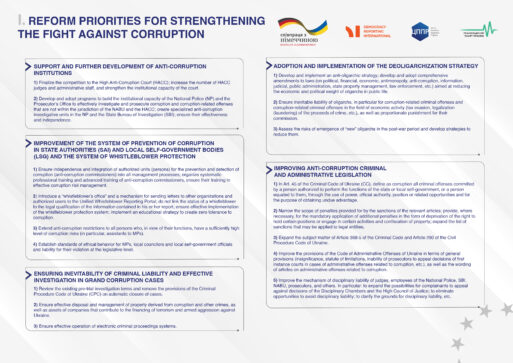
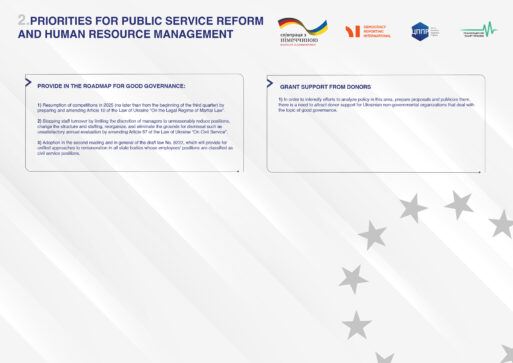
Experts of the Center of Policy and Legal Reform, together with the RPR Coalition, prepared and presented infographics with priorities for changes in five areas of the ‘fundamentals’.
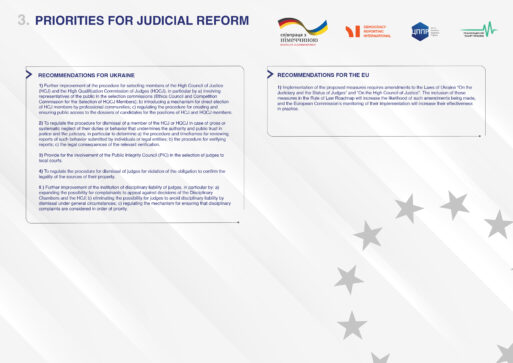
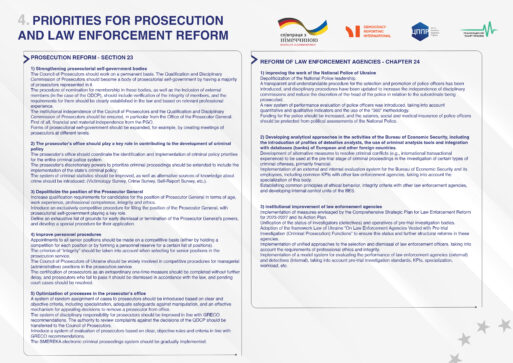
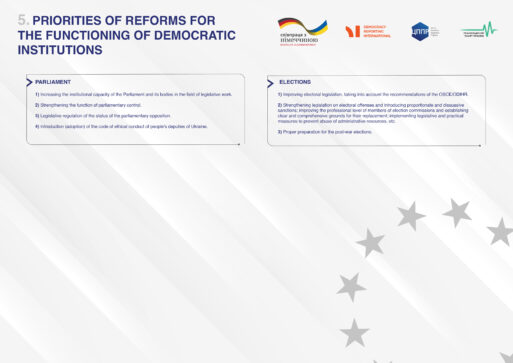
In particular, they focused on judicial and prosecutorial reform. Roman Smaliuk, Head of the Judiciary Department at the Center of Policy and Legal Reform, said: “The latest report of the European Commission generally presents the priorities of judicial reform. We absolutely support them and are ready to join their implementation in practice. I want to focus more on what is not yet included in the reports on EU enlargement. Although, in our opinion, these measures are important in the context of judicial reform in Ukraine.”
And Yevhen Krapyvin, Head of the Criminal Justice Department at the Center of Policy and Legal Reform, spoke more about the changes in the prosecutor’s office: “Prosecution is a component of justice. The report on the enlargement [of the European Union – ed.] is increasingly focusing on the real problems that exist in the prosecution system. First of all, the report explicitly mentions that the current procedure for appointing and dismissing the Prosecutor General is too politicized. This influence needs to be reduced, so the thesis about the need to depoliticize the position of the Prosecutor General is already finding support at the EU level.”
Asier Santillian, Head of the European Integration, Good Governance, Rule of Law and Civil Society Section at the Delegation of the European Union to Ukraine, joined the discussion of the above priorities. He assured that each area mentioned by the CPLR experts is important. And today, Ukraine is indeed showing good progress in reforms on its way to the EU: “Only in one part – Section 2 on the free movement of workers – there were some problems, but in general, in other things your movement is good. Now we are going through the screening process, some bilateral meetings. Based on them, there will be a report on the results of the screening, some recommendations for clusters – sometime in late January 2025.”
In parallel with the screening, the Ukrainian government is preparing a list of measures to implement the recommendations mentioned in the European Commission’s report, said Oleksandr Ilkov, Director General of the Government Office for Coordination of European and Euro-Atlantic Integration: “The fundamental cluster is probably the key in the negotiation process. It really is the so-called heart of the negotiation process, and believe me, any meeting we have with our European partners also begins with a discussion about corruption, independent justice, human rights – all these things that are concentrated in this cluster. We are waiting for the results of the screening report on this cluster. Now, just like last year. We are preparing an action plan to implement the recommendations contained in the European Commission’s report as part of the enlargement package.”
The discussion was attended by representatives of the government, parliament, and civil society, just as it is globally on the entire European integration track in Ukraine. This qualitatively distinguishes our country from other candidate countries, because European integration is not only the responsibility of the government, but also a comprehensive, national process. This is a real innovation of Ukraine.
“Ukraine has given the EU enlargement a new dynamic,” said Daria Gaidai, Deputy Head of the Office of the Vice Prime Minister for European and Euro-Atlantic Integration, ”Ukraine and Moldova are part of this new enlargement process that is developing in the European Union. The European Commission makes enlargement one of its priorities. Today, Ukraine is being evaluated according to the steps we have taken on the European integration path, not the years we have been in this process.”
Finally, another panelist, Larysa Bilozir, MP, Head of the Subcommittee on Administrative Services and Administrative Procedures of the Verkhovna Rada Committee on Organization of State Power, Local Self-Government, Regional Development and Urban Planning, shared Ukraine’s legislative victories on the way to implementing the fundamental cluster: “Despite the fact that we have made good progress in the process of European integration, we should not lose our sense of urgency. Because everything we have achieved may lose its meaning if we do not hold our ground at the front. Our parliament has adopted the Law on Administrative Procedure, which has been a requirement of not only the EU but also NATO (i.e., the MAP) for years. This is, without exaggeration, the main anti-corruption law.”
The Law provides for unified rules of relations between citizens and the state – instead of dozens of scattered and contradictory laws that exist today. This includes administrative services (obtaining passports, permits, licenses) and inspections.
We still have a lot of legislative changes on the way, but it is in cooperation with all stakeholders – and above all, civil society itself – that Ukraine’s priorities will become clear, its position balanced, and its European integration inevitable.
The event was organized by the Centre of Policy and Legal Reform in partnership with the Reanimation Package of Reforms Coalition, the Ukrainian Center for European Policy and Democracy Reporting International (DRI) within the framework of the Democratic Integration, Resilience and Engagement (Ukraine-DARE) project, which is implemented with the financial support of the Federal Foreign Office of Germany. The opinions and views expressed during the event do not necessarily reflect the position of the Federal Foreign Office of Germany.


