Reanimation package of reforms > News > Longreads > Ensuring Effective Democratic Institutions on the Path to the European Union: The Practice of a Democracy at War
Even under martial law, Ukraine is moving towards full membership in the European Union. Ukrainian democracy is fighting back against the aggressor’s attacks and getting rid of the past, while at the same time working on reforms and striving for a European future.
In the field of European integration, an important event was the start of official negotiations on Ukraine’s accession to the EU (June 25, 2024). Since then our country has been moving to the most difficult period – achieving the membership criteria, in particular, bringing national legislation in line with EU law and ensuring its effective implementation. Thus, Ukraine’s European integration vector is becoming more defined and concrete.
As is well known, according to the current EU enlargement methodology, accession negotiations begin with the opening of a cluster of “fundamental reforms” (in EU terminology – “Fundamentals”) and end with the closure of this cluster. This is justified, since it is the progress in the Fundamentals that will set the tone and perspective for further negotiations.
At the same time, the experience of candidate countries from the Western Balkans shows that reforming the national legal system in accordance with the fundamental standards and values of the EU is the most difficult.
One of the pillars of the Fundamentals is the part on the functioning of democratic institutions. Strengthening democratic institutions, even without the incentive of EU membership, is a priori one of the most important tasks for our country. And the work on this is ongoing. And the inclusion of this section in the Fundamentals once again emphasizes its importance on Ukraine’s European integration path.
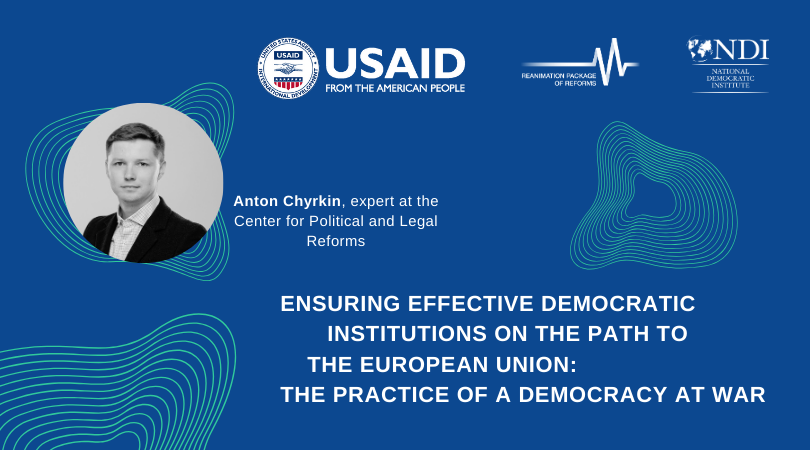
Therefore, ensuring the functioning of strong democratic institutions should become, on the one hand, a driving force for Ukraine’s full membership in the EU, and, on the other hand, a strong support for a democracy at war. Anton Chyrkin, an expert at the Center for Political and Legal Reforms, a RPR Coalition member NGO, spoke about how to achieve this in a special report for the RPR Coalition.
Participation of the Ukrainian Parliament in the European Integration Process
Since obtaining the EU candidate status (June 23, 2022), our country has demonstrated, and European partners have seen, significant potential in Ukraine’s ability to quickly and effectively fulfill the requirements and tasks of the EU. This is evidenced by the implementation of seven recommendations of the European Commission.
In this context, it is important to emphasize that the Verkhovna Rada of Ukraine (hereinafter referred to as the VRU – Ed.) played a crucial role in the implementation of the relevant recommendations. The Law of Ukraine “On the Constitutional Court” was amended to introduce real competition, and one vacant position has already been filled, and the laws “On Media”, “On National Minorities (Communities) of Ukraine”, and “On Lobbying” were adopted.
The Ukrainian parliament, as the country’s main representative institution, should continue to be at the forefront of our country’s European integration track. It should show the prospects and practice of reforms by its own example.
Strengthening the institutional capacity of the Verkhovna Rada is the key to Ukraine’s successful European integration vector. One of the steps is to improve the interaction between the Parliament and the Cabinet of Ministers of Ukraine. Relevant tools may include:
– taking into account the unified state policy framework in planning the legislative work;
– ensuring that the legislative work plan and the session agenda prioritize consideration of European integration bills;
– ensuring governmental expertise in draft laws at all stages of the legislative cycle;
– establishing cooperation at the official and political levels by defining the functions of structural units and officials responsible for such cooperation, especially in terms of communication.
The second priority legislative step in the VRU’s European integration activities should be the adoption of a law on the adaptation of national legislation to the provisions of the European Union acquis in terms of fulfilling Ukraine’s international legal obligations in the field of European integration (draft law No. 8242). This law should unify and accelerate the procedure for adopting European integration laws (fast track). In addition, the law enshrines important and useful provisions for interaction with the government in the relevant legislative process.
The third important element of strengthening the capacity of the Parliament should be the adoption of the Code of Ethics for Members of Parliament (Draft Law No. 8327). Legally established principles of parliamentary ethics, the procedure for monitoring compliance with such rules, appropriate sanctions for their violation, and the procedure for bringing to disciplinary responsibility are common practice in European democracies and an important component of developed parliamentarism.
Moreover, the regulation of parliamentary ethics was also emphasized in the Roadmap for Internal Reform and Institutional Capacity Building of the Verkhovna Rada (European Parliament Mission).
Fourthly, the stability and clarity of laws are some of the most important indicators of the state of the legal system in the EU. It is not news that the quality of domestic legislation needs to be improved. And some steps have been taken to improve the legislative process, but not without a fly in the ointment.
The adoption of the law “On Lawmaking” was undoubtedly positive news. However, the law will become fully operational only one year after the date of termination/cancellation of martial law. In addition, the provisions of the law that provide for the introduction of analytical documents of public policy will be enacted in general five years after the date of termination/cancellation of martial law. That is, the provisions of the law that could improve the quality of legislative acts and improve the interaction between the VRU and the CMU in the legislative process are postponed.
Another legislative act that brings us closer to the standards of lawmaking and ensuring citizen participation in the management of public affairs is the recently adopted law “On Public Consultations.” This is positive news, including for European integration. However, the law does not provide for mandatory public consultations by MPs, in particular, in the online format before the draft law is registered.
The majority of draft laws are submitted by parliamentarians, while government officials may submit their draft law to MPs and not go through the public consultation procedure.
So, whether we can assume that the quality of laws has improved due to public consultations is a relevant question (at the time of writing, the law was sent to the President of Ukraine for signature).
In general, we should recognize that the Ukrainian parliament is working and fulfilling its constitutional functions. The springboard and opportunities to continue the parliamentary reform are obvious. Therefore, it is very important to continue the relevant work and ensure the European integration movement of the state by law.
Democratic post-war elections as a prerequisite for successful European integration
One of the priorities of the state after the abolition/termination of martial law will be the organization of the first post-war elections. And such elections, first of all, must comply with the generally recognized democratic principles of the electoral process. Moreover, holding postwar elections will be something of an additional test on the European integration path.
Preparatory work in this regard is being carried out by both state bodies – the Verkhovna Rada of Ukraine, the Central Election Commission, and representatives of civil society. In particular, the Central Election Commission has established three working groups to develop:
– mechanisms for updating voter information to ensure the conduct of post-war elections;
– proposals for organizing the voting of voters who reside or are on the territory of a foreign state on the day of the election;
– an action plan for organizing the preparation and holding of post-war elections.
In the short term, the priority is to adopt the draft laws on election campaign financing, the procedure for verifying financial statements, ensuring a balanced representation of women and men in parliament and local councils, and raising the level of professionalism of election commission members.
And of course, special attention should be paid to the preparation and adoption of a special law on the specifics of organizing and conducting national elections after the termination (abolition) of martial law in Ukraine.
Local public administration as an integral part of European democracy
The reform of local self-government and territorial organization of power launched in 2014 has proven to be efficient. The underlying principle of decentralization has worked.
The transfer of powers from central authorities to local governments, increased financial independence of communities, voluntary association and cooperation of territorial communities have given a significant impetus to the development of communities in Ukraine.
In general, these reforms are considered to be among the most successful in the history of independent Ukraine.
At the beginning of the full-scale invasion, municipal authorities were among the first to face the burden and challenges of the war: territorial defense, infrastructure, social security, internally displaced persons, etc. Whether communities would have withstood such a blow without decentralization and the corresponding capacity of local budgets is a rhetorical question.
There is no need to talk about expanding the powers of local self-government under martial law, especially given the functioning of military administrations. And in this regard, the issue of delimiting the powers of central and local authorities is quite acute and needs to be resolved.
It’s not hard to assume that the restrictions imposed by municipal authorities and the violation of the rights of local communities will be a real trigger for European partners.
However, some positive steps have been taken to develop municipal authorities, particularly in 2023-2024. A new Law of Ukraine “On Service in Local Self-Government Bodies” was adopted (however, it will come into force no earlier than six months after the termination or abolition of martial law). Legislation on the development of democracy at the local level has been amended (draft law No. 7283 has been signed by the President of Ukraine since May 2024).
The development of municipal democracy and public administration at the local level will definitely be one of the defining aspects of Ukraine’s further European integration movement. About 80% of EU policies are implemented at the local level.
And in this direction, Ukraine needs to continue working and solve urgent problems, namely:
– a model of state supervision over the legality of decisions of local governments should be developed;
– a central executive body responsible for the development of regional and local policy, as well as decentralization, should be created;
– clear criteria for the establishment of military administrations (to prevent excessive narrowing of local government powers) should be defined;
– communication between communities and the central executive branch should be improved;
– personal income tax should be returned to local budgets;
– legal entity status should be granted to communities.
Decentralization must go on…
Conclusion
The focus of the article on these democratic institutions is not accidental. In parallel with the implementation of reforms in accordance with the Fundamentals cluster, it is also necessary to take into account the generally recognized Copenhagen criteria, in particular, the political ones. The central place in the political part of the Copenhagen criteria is occupied by the institutions of parliament, elections and public administration.
The structure of the current methodology of EU enlargement, in particular in the context of Ukraine, includes the Rule of Law area in the negotiating units 23 “Judiciary and Fundamental Rights” and 24 “Justice, Freedom and Security”.
At the same time, we recognize the all-encompassing nature of the fundamental principle of the rule of law and its impact on all sectors. Therefore, all current and potential reforms in Ukraine, including those aimed at strengthening democratic institutions, must be based on the rule of law, even under martial law.
Ensuring and implementing reforms to strengthen democratic institutions in accordance with the rule of law is the most difficult. The experience of a number of countries confirms this.
Strengthening democratic institutions will definitely be even more effective with the involvement and support of international partners. All further reforms will require both institutional and financial support. Homework and cooperation with international partners will undoubtedly be the key to Ukraine’s successful European integration. In this context, it is also important to emphasize the interaction between the government and civil society. As an example, representatives of the public, including the Reanimation Package of Reforms Coalition, are already involved in providing proposals for the development of roadmaps in the rule of law.
The Coalition, together with experts, is carrying out comprehensive work aimed at introducing the institutes of jury trial and magistrates in Ukraine, as well as reforming legal education. The RPR team, together with the Center for Political and Legal Reforms and the DEJURE Foundation, has developed and submitted to the Ministry of Justice of Ukraine proposals on jury trials, magistrates and legal education reform.
At the same time, we emphasize that Ukraine is going through its unique path as a warring democracy and, at the same time, as a state that implements European integration reforms based on the rule of law.
Anton Chyrkin, expert of the Center of Policy and Legal Reform, NGO-member of the RPR Coalition
This publication was prepared by the Reanimation Package of Reforms Coalition with the generous support of the American people through the United States Agency for International Development (USAID) under the Ukraine Responsible and Accountable Politics Program (U-RAP), implemented by the National Democratic Institute (NDI), International Republican Institute (IRI), and International Foundation for Electoral Systems (IFES). The opinions expressed in this publication are those of the experts and do not necessarily reflect the views of the United States Agency for International Development (USAID) or the United States Government.


