Reanimation package of reforms > News > Analytics > Economic Security Bureau of Ukraine: should we expect a reform?
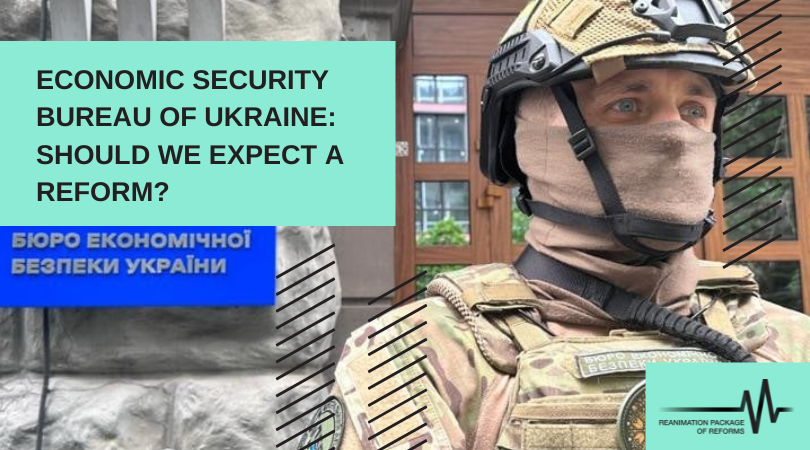
Have you heard of the Economic Security Bureau of Ukraine? It is a pre-trial investigation body for criminal violations in the economy. Its key goal is to counteract economic crimes against the state. But the relatively new body (the Bureau started operating in 2021) has gained a negative reputation among parliamentarians, experts, and civil society. “Forceful” methods of investigation, constant change of leadership – there is a need to reform the ESB.
On December 29, 2023, the Cabinet of Ministers approved a draft law to improve the work of the Bureau. The Centre of Policy and Legal Reform analyzed whether this draft law will contribute to the ESB reform.
The draft law “On Amendments to the Criminal Procedure Code of Ukraine and Other Legislative Acts to Improve the Work of the Economic Security Bureau of Ukraine” concerns the improvement of the mechanism for executing the decisions of the investigating judge, court on temporary access to belongings and documents and on searching other property, as well as the jurisdiction of certain criminal offenses, ensuring transparency and clarity of the competitive procedures for electing the director of the ESB, as well as the Commission for Evaluation (Audit) of the ESB’s Performance.
The draft law was developed as part of the implementation of fiscal structural reforms envisaged by the Memorandum on Economic and Financial Policy of March 24, 2023 and June 19, 2023, with the aim of improving the legal framework of the ESB. According to the updated $17.5 billion Extended Fund Facility (EFF) program, the relevant legislative initiative to “reset the ESB” should be adopted by the end of June 2024.
The government’s initiative to reform the Economic Security Bureau has a long history. Despite the intentions to reform the tax police, increase the effectiveness of combating financial and economic criminal offenses, and move from “forceful” to “analytical” methods of investigation, in particular to reduce pressure on business, the goal was not achieved.
As a result, in 2022, the Temporary Investigation Commission of the Verkhovna Rada was established to investigate possible violations of Ukrainian legislation by officials of the Economic Security Bureau of Ukraine, state authorities and other state bodies exercising powers in the field of economic security, which could have led to a decrease in revenues to state and local budgets. The TIC report contains critical remarks on the work of this body and emphasizes the need for its reform.
In February 2023, the Verkhovna Rada Committee on Finance, Taxation and Customs Policy found the work of the Economic Security Bureau of Ukraine’s management unsatisfactory and recommended that the Government “reboot” the Bureau’s management, clarify the procedure for holding competitions for positions in it and certify the employees of this body.
Finally, on October 13, 2023, the relevant Committee recommended that the Verkhovna Rada adopt as a basis the draft law No. 10088 “On Priority Measures for Reforming the ESB” and its alternative No. 10088-1. These draft laws provide for:
Finally, on November 8, 2023, the European Commission provided a Report on Ukraine’s accession to the European Union, namely an assessment of the reform of Ukraine’s legal system and its approximation to the requirements of the EU acquis. Among other things, the document mentions the need for a qualitative reform of the ESB 7 times and states that the launch of this body has not achieved the goal set for it. Therefore, reforming the ESB is not only a part of national policy, but also one of the requirements on the way to European integration.
Thus, despite the work done to develop steps to reform the ESB and their respective approval by the relevant Verkhovna Rada Committee, the Government has in some ways started the process of implementing the EU recommendation from the beginning. On December 29, 2023, the Cabinet of Ministers approved the draft law “On Amendments to the Criminal Procedure Code of Ukraine and Other Legislative Acts to Improve the Work of the Bureau of Economic Security of Ukraine”, which will soon be submitted to the Verkhovna Rada. It has been criticized by parliamentarians and the public, as it does not achieve the goal of systemic reform of this pre-trial investigation body and postpones it until the end/liquidation of martial law, creates preconditions for manipulation of the categories of positions subject to certification, etc.
In January 2024, the Speaker of the Verkhovna Rada, Ruslan Stefanchuk, responded to criticism by saying that the draft law on reforming the ESB “must be developed in compliance with NATO and EU standards, otherwise we may lose the trust of our partners.”
Today, the reform of the Economic Security Bureau is questionable, as there is no state policy on this issue and no unified vision among those involved in this process. On the one hand, there are parliamentary initiatives and preliminary work done by the TIC, which allows us to reasonably assert the need to reform this body, on the other hand, the Government has its own vision, which can be called competing, as it is moderate. At the same time, both the EU and other international partners of Ukraine expect Ukraine to take systematic steps to improve the fight against financial and economic criminal offenses, reduce pressure on business, in particular by improving the efficiency of the specialized pre-trial investigation body.
Reforming the ESB is one of the priorities in the field of law enforcement reform in 2024, so it is imperative to achieve a consolidated vision of the Government, Parliament, and professional environment as soon as possible to ensure high-quality and systematic reform of this law enforcement agency.


