Reanimation package of reforms > News > Columns > Crisis update: how the EU is changing under the influence of Putin’s war
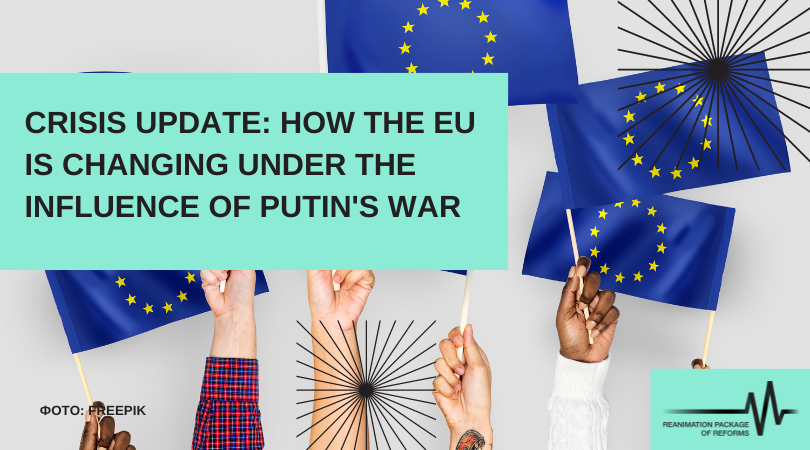
Russia’s attack on Ukraine since 2014 and its large-scale invasion since 2022, along with several other developments in and around Europe, have again raised the fundamental question of what interests and values are or are not shared by different European countries. In this situation, the issue of changes in the work of the main EU institutions that are expected to take place in 2024-2025 is gaining new importance.
Today and in the coming years, perhaps, the main task facing Brussels is as follows: what practical implications should the new military, geopolitical and geo-economic situation in Europe have for the EU’s policy towards its closest neighbors? Andreas Umland, Senior Research Fellow at the Institute for Euro-Atlantic Cooperation, analyst at the Stockholm Center for East European Studies (SCEEUS) at the Swedish Institute of International Affairs (UI), attempted to answer this question for Yevropeiska Pravda.
Readiness for enlargement
The EU member states and non-EU European countries are already interconnected by a number of transnational structures. These include, on the one hand, old institutions such as the Council of Europe (CoE), the Organization for Security and Cooperation in Europe (OSCE), the European Economic Area or the EU-Turkey Customs Union, and, on the other hand, more recent innovations such as the Black Sea Synergy, the Eastern Partnership (EaP) program or the Lublin Triangle.
Some of these structures either had Russia as a member in the past, like the Council of Europe, or continue to include Russia as a member today, like the OSCE. However, they were not enough to prevent a dramatic escalation of the Russian-Ukrainian war in 2022.
Roughly the same can be said about the recent military clashes between Armenia and Azerbaijan, countries that are equally members of the Council of Europe, the OSCE, and the EaP.
The recent momentous events in Europe point to the need for more than cosmetic changes in the EU’s relations with non-EU European countries for two reasons.
First, Brussels’ previous approaches and initiatives were insufficient to ease or counteract the tensions in Eastern Europe that led to the war. They needed to be revised in 2022 and need to be revised today against the backdrop of their clear inability to ensure peace in Europe.
Second, the ongoing war and its many consequences around the world require new approaches and actions that can help save the Ukrainian state from destruction and the European security order from collapse.
A fundamental revision and at least partial reconfiguration of the EU’s former policy toward non-EU countries, especially in Europe itself, is already underway.
The most notable change over the past two years has been the emergence of new official candidates for EU membership.
In 2022, Ukraine and Moldova were granted this status, and in 2023, it was the turn of Georgia and Bosnia and Herzegovina.
While the Western Balkan countries have had the prospect of EU membership for more than 20 years, the fate of the “associated trio” of Ukraine, Moldova, and Georgia remained unclear.
It was only in response to Russia’s attack and Ukraine’s application to join the EU in the spring of 2022 that the European Commission took the initiative to persuade member states to change their attitudes not only toward Kyiv but also toward Chisinau and Tbilisi.
At the end of 2023, the European Council approved the start of accession negotiations with Ukraine and Moldova and accepted Georgia as a candidate country. In doing so, Brussels finally clarified the still unclear purpose of the three particularly large association agreements it had concluded with these three countries back in 2014.
A family of shared values
Another important institutional change in response to the start of Russia’s large-scale invasion of Ukraine in February 2022 was the creation of the European Political Community (EPC), an initiative symbolically launched by French President Emmanuel Macron on May 9, 2022.
A total of 47 states, including Turkey, have agreed to join this initiative, thus creating a new pan-European structure for consultations and resetting the EU’s relations with non-EU countries.
The creation of the EPC can be seen as an expression of a new sense of common European national interest in the face of Russia’s brutal attack on one of Europe’s largest countries. It may also signify a new sense of community among those EU and non-EU states that uphold European values and want to respond to the broader normative challenge posed by Moscow and its anti-Western allies.
The prospects for the EPC and the possible impact of the motivations that led to its creation, however, remain unclear. They will depend (not only, but crucially) on the EU’s willingness, ability, and success in deepening relations and integration with European countries that are not currently members of the EU.
Since the latter are a disparate group of states, new joint initiatives such as the EPC can only function as a discussion and networking forum.
The EPC and older pan-European organizations such as the Council of Europe or the OSCE can be useful for discussing certain ideas among their dozens of member states. However, overarching initiatives such as the EPC will play a lesser role in the concrete planning and practical implementation of legal, institutional and material improvements in relations between the EU, its member states and non-EU countries in Europe.
Bilateral and multilateral deepening of cooperation in EU relations is not only an urgent task in relation to those European countries that have been most directly affected or threatened by Russia’s military attack, i.e. Ukraine, Georgia, Moldova and Armenia.
It is also a necessity in relation to other non-EU European countries – in a broad sense, from Iceland and the United Kingdom to Azerbaijan and Turkey.
The main areas of such cooperation today are national and transnational security and resilience.
Promoting wider exchange, cooperation and unity in various fields related to preventing or at least deterring Russian and other anti-Western attacks – kinetic, hybrid, psychological, political, economic – on Europe has acquired an existential dimension.
Not only the quality, but also the survival of European democracies and their various alliances, especially the EU, depends on it.
Moreover, deepening and expanding cooperation in areas not directly related to the defense of the security, integrity, and sovereignty of European countries will also help make the European community of states stronger.
Brussels and other EU capitals can and should take more effective trans-European action in a variety of areas, from promoting industrial innovation to ensuring more effective social and environmental protection, as well as promoting gender equality, scientific progress and cultural exchange.
The desire for greater cooperation and integration in these and other areas across Europe today is not only an expression of the normative privilege of transnational humanism, Europeanism, and/or liberalism.
It has become a matter of self-preservation.
Russia and other anti-Western states will look for weaknesses in the European community of states. They will target these countries – as Moscow has been doing with Ukraine since 2014 – not only to attack their democratic policies and open societies. They will try to turn the military, institutional, and/or societal weaknesses of individual countries into fundamental challenges for the whole of Europe.
An old adage in political science states that not only do states wage wars, but also states are made by wars. For Europe as a whole and the EU, it is now necessary to test whether the transnational extrapolation of this rule is possible. Will the ongoing Russian-Ukrainian war strengthen or weaken the European community of states? The coming years will tell.


