Reanimation package of reforms > News > Events > Civil Society Presents Tobacco Tactics Resource: Strategies and Tactics of Tobacco Companies Against Public Health
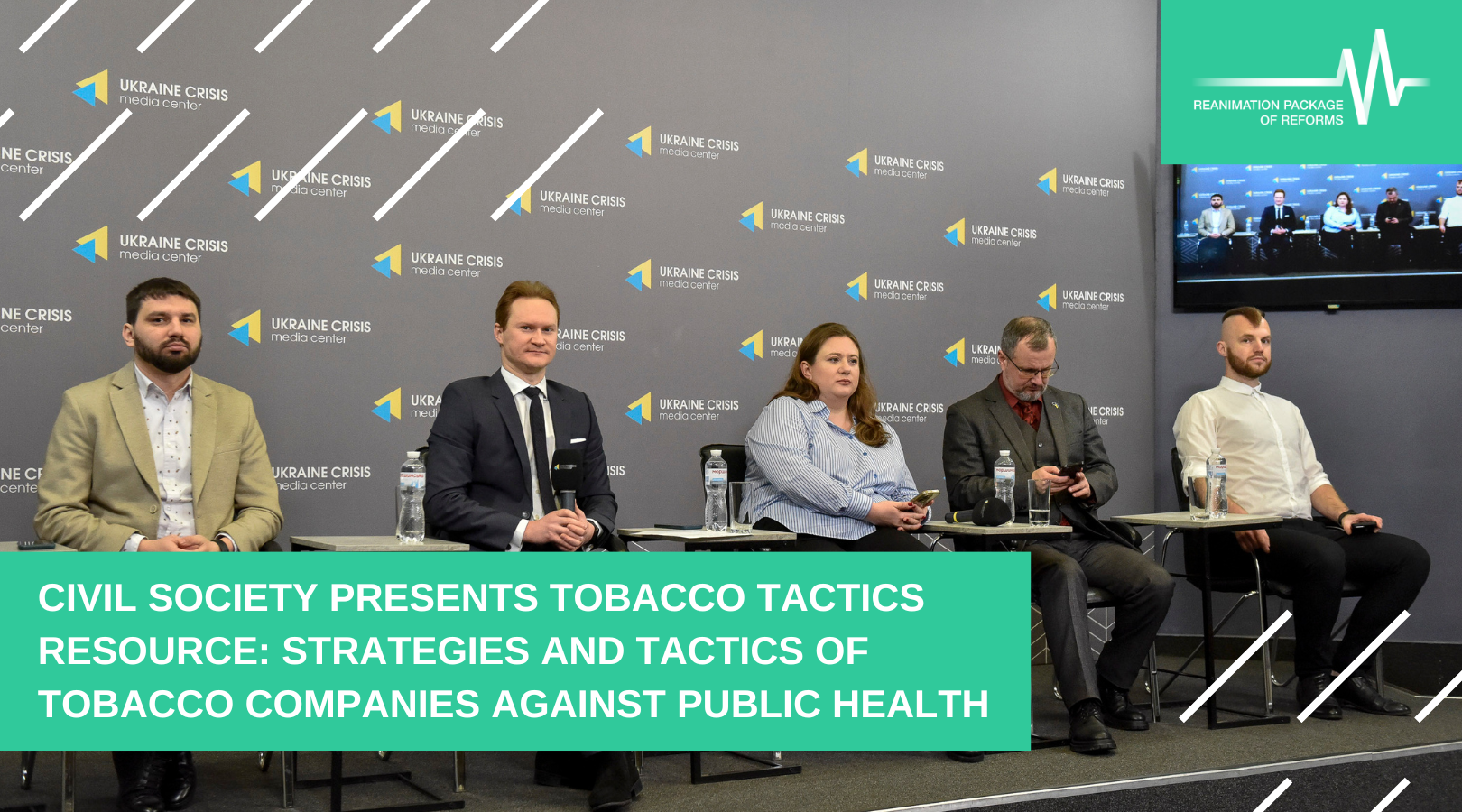
On 16 December 2025, the civil society organisation Life held a press conference titled “Tobacco Tactics in Ukraine: How the Tobacco Industry Undermines Public Health Protection” at the Ukrainian Crisis Media Center.
During the event, the public was introduced to the updated Tobacco Tactics information and thematic resource. Its purpose is to monitor and document the methods and forms of interference by the tobacco industry in public health policy aimed at protecting the population from the harm caused by tobacco and nicotine; to identify key influence groups; and to inform politicians, journalists, experts, and the wider public about identified cases of such interference.
The analytical content published on the website is based on monitoring of open sources, including media reports, working group meetings, publicly available information, and data from civil society and expert organisations. “Public health is the foundation for restoring Ukraine’s human capital. The tobacco industry is an enemy of people’s health, targeting children and young people. As civil society, we systematically track the tobacco industry’s interference in health policymaking and document its methods, influence groups, and the involvement of MPs and government officials,” said Dmytro Kupyra, Programme Director of the NGO Life.
Article 5.3 of the WHO Framework Convention on Tobacco Control (WHO FCTC), ratified by Ukraine in 2006, requires the protection of public health policy development and implementation from the commercial and other vested interests of the tobacco industry. This principle has been incorporated into national legislation, including Law of Ukraine No. 2899-IV, which establishes the priority of public health over the commercial interests of tobacco companies and their affiliates.
Olha Lymar, Executive Director of the Reanimation Package of Reforms Coalition, emphasised: “Interference by tobacco companies comes at a high cost for Ukraine—not only in terms of public health, but also with regard to international reputation and compliance with international commitments. The influence of the tobacco industry slows the alignment of Ukrainian legislation with EU law, particularly in the areas of excise taxation and combating illicit trade, and hampers the implementation of the WHO Framework Convention on Tobacco Control.”
Serhii Mytkalyk, Chair of the Board of the NGO Anti-Corruption Headquarters, noted: “Since September, Ukraine has launched the Transparency Register, designed to ensure openness of lobbying influence on decision-making processes. Tobacco companies and industry associations occupy a visible place in the register, focusing their activities on influencing policies related to the production, distribution, taxation, and advertising of tobacco and nicotine products. Lobbying existed before as well, and what we see now is only the tip of the iceberg of tobacco industry interference in public policy.”
Bohdan Kashanyk, lawyer at the Centre of Democracy and Rule of Law, stressed: “The WHO clearly defines such practices as incompatible with good governance in public health. Protecting public health policies from tobacco industry influence is not only a requirement of the WHO FCTC, but also a fundamental characteristic of a lawful, democratic, and people-centred state.”
Tobacco industry interference results in budget shortfalls and significant public spending to address the burden of disease. Each year, Ukraine loses 3.2% of GDP due to healthcare costs linked to active and passive smoking, loss of productivity, and premature deaths.
Illia Neshchodovskyi, Head of the Analytical Department of the ANTS Network, explained: “In wartime, one effective way to replenish the budget is to tax harmful products such as tobacco and alcohol. That is why excise taxes on these goods must increase—to support the budget and protect public health—while law enforcement effectively combats illicit trade. However, the tobacco industry systematically promotes preferences in its own interests, such as a 25% excise discount for heated tobacco products. Initiatives to stimulate tobacco cultivation in Ukraine are also being lobbied, directly contradicting the WHO FCTC, which calls for the development of alternative, economically sustainable livelihoods.”
Given these challenges, the state and society must act jointly to protect public health policies. Media play a crucial role by exposing misconduct, abuse of power, and informing the public.
“Resources such as Tobacco Tactics, Industry Connections, and the anti-award Golden Braid are high-quality tools for journalists researching the topic and for voters who have the right to know which politicians acted in the commercial interests of the tobacco industry at the expense of public health, especially children,” noted Natalka Sokolenko, blogger and Ukrainian Radio host.
Each year, approximately 100,000 Ukrainians die from tobacco-related diseases. As current consumers are lost, the tobacco industry deliberately targets children and young people for nicotine addiction. As a result, the prevalence of new tobacco and nicotine products among children significantly exceeds that among adults.
One of the first publications on the updated Tobacco Tactics platform analysed the consideration of the Protocol to Eliminate Illicit Trade in Tobacco Products. Despite claims about illicit trade, the tobacco industry avoids supporting the Protocol as a key international instrument to combat it. International data show that the tobacco industry’s share in supplying illicit products may reach 60–70%.
Restricting tobacco industry interference in public health policymaking is a necessary condition for overcoming the tobacco and nicotine epidemic, particularly among children.
Photo credit: Ukrainian Crisis Media Center


