Reanimation package of reforms > News > Longreads > Are we all judges? Will the introduction of jury trials solve the problem of trust in the system?
Have you ever heard of the town of Marbella in the south of Spain? Probably not many Ukrainians know about this place, unlike the Spaniards. After all, it was here that the largest trial in Spanish history took place, which lasted 7 years and ended in 2013 with the convictions of more than 50 former mayors, businessmen, and other prominent figures.
After hundreds of trials, dozens of suspects were found guilty of numerous financial frauds ranging from illegal construction permits to bribery and money laundering, which together caused $2.5 billion in losses and permanently damaged the city’s reputation. The jury trial was only a small part of this large-scale case and concerned relatives of the deputy mayors of Marbella who were suspected of fraud. Although jury participation in corruption cases of this magnitude is rare, the fact that it was involved is important and may indicate public confidence in this institution.
Spain is not the only country in the European Union with a jury trial. Over the years, Sweden, France, Bulgaria, Belgium, Norway, Estonia and other countries have introduced jury trials, albeit with different variations in their application. The experience of these countries can be a very valuable reference point for Ukrainian society, which has a realistic prospect of introducing the classical jury trial model in the future.
For several years now, three groups of draft laws on jury trial reform have been under consideration in the Ukrainian parliament. In particular, the draft laws registered by MPs (from the Servant of the People party (3843, 3844, 3845) and Serhiy Vlasenko (2709-1, 2710-1), as well as those introduced by the Cabinet of Ministers of Ukraine (4190, 4191, 4192). All of them provide for the introduction of the so-called “classical model” of jury trial in Ukraine, in which the jury, independently of a professional judge, renders a verdict on the guilt of a person in committing a crime. This model is intended to replace the “continental” model used in Ukraine, where a jury, together with a professional judge, considers the case and makes a decision.
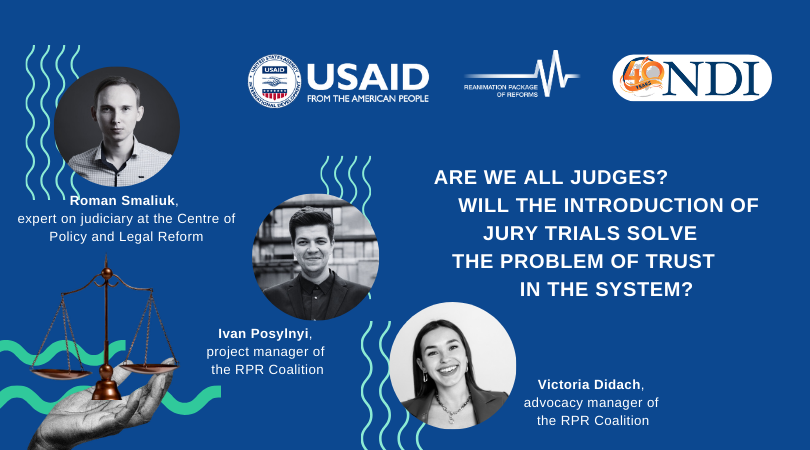
However, the classic jury trial has both advantages and disadvantages. Roman Smaliuk, expert on judiciary at the Centre of Policy and Legal Reform, Victoria Didach, advocacy manager of the Reanimation Package of Reforms Coalition, and Ivan Posylnyi, project manager of the Coalition, considered them and tried to understand how a jury trial can help administer justice using the example of Spain.
Why do we need a jury trial at all?
The most common answer is to increase trust in the judicial system, especially if its reputation is not spotless. A jury is usually composed of citizens who are not professional judges. Although logically, it is they, i.e. judges, who should be able to deliver a fair verdict, trust in the courts is often low, as we see in Ukraine.
The idea of a classic jury trial is to allow ordinary citizens, members of local communities, to decide whether a person is guilty of a crime instead of professional judges. Experts name several advantages of introducing jury trials:
There is another significant advantage that goes far beyond the interests of justice. Involving citizens in jury service not only raises awareness of the judicial system, but also has a positive impact on their socio-political engagement, such as participation in elections or civic activities. Back in the 19th century, Alexis de Tocqueville noted that since jurors “pay attention to things other than their own cases, they fight against individual selfishness, which corrodes society like rust.”
In other words, the jury institute can be seen as one of the ways to form active and responsible members of society.
At the same time, serious risks and shortcomings of this institution are also noted, in particular:
However, these challenges can be partially minimized by choosing a certain model of jury trial and adapting it to national legislation. We will discuss them below.
Jury models and the Spanish experience
In most EU member states, there is a mixed model of the court, when the jury determines innocence or guilt together with the judge. The Ukrainian parliament is considering the possibility of introducing a different, classical model, when the jury makes a verdict instead of the judge.
On the one hand, a classic jury trial is a more difficult institution to develop, but at the same time, this model protects jurors from possible influence of the judge and contributes to the legitimacy of the process. Let’s take a look at how this model of court works using the familiar example of Spain.
Although jury trials were first introduced in Spain in the 19th century, it was only at the end of the last century that they took on their modern form. In a Spanish trial, there are 9 jurors who are randomly selected from among ordinary citizens, usually members of the local community. In 2018, more than two and a half thousand Spaniards served as jurors.
Together with a professional judge who presides over the trial but does not participate in the decision-making process, the jury hears the prosecution and the defense, and after deliberations, renders a verdict on the guilt of the accused.
Not all Spanish citizens can become jurors – politicians, military personnel, or people under the age of 25 are deprived of this right, for example.
After the draw of lots determines the preliminary list of jurors for a particular case, the parties have the right to reject a certain number of candidates, arguing their position. In addition, the defense has the exclusive right to reject four more out of the 20 candidates without any explanation. The prosecution does not have this option.
When the jury is finally selected, the case is tried on the merits, and the jury hears arguments from both sides, including the presentation of evidence and witnesses. To reach a verdict, the jury retires to the deliberation room. The deliberations continue until the jury has 5 votes in favor of the defense or 7 votes in favor of the prosecution out of 9.
An important point: according to the researchers, the peculiarity of the Spanish jury trial is that the jury must give reasons for its verdict, which allows to appeal the decision if one of the parties to the case disagrees. It is noteworthy that the jury does not determine the amount of punishment – this competence remains exclusively with the presiding judge.
Why is the Spanish experience useful?
The innovations proposed in the Ukrainian draft laws have a lot in common with the Spanish jury trial, as they are based on the same principle – the classical model of this institution. Although the idea of ordinary citizens conducting court proceedings is attractive to society and often finds wide support, it is necessary to be able to take advantage of this support, which requires extensive discussion of the draft laws. It is interesting that immediately after the Spanish jury trial received its modern look in 1996, almost half of the citizens had positive expectations and expressed confidence in this institution, as evidenced by a public opinion poll at the time. However, a year later, the situation changed, and only one-third of citizens remained positive about jury trials.
London-based researcher Mike Huff attributes this negative change to the high-profile Ottega case of 1996, when a jury acquitted a defendant of murdering two police officers under controversial circumstances, undermining the reputation of the newly created institution.
This case epitomizes the importance of comprehensive preparation for the introduction of jury trials and reminds us once again that the credit of public trust can be short-lived and the cost of a mistake can be high. That is why Ukrainian civil society is faced with the task of developing a concept of successful “localization” of the classical jury trial model. In this context, there are many questions that require reasonable answers: What crimes will be tried by jury? Who will have the right to become a juror? How many jurors should consider a court case and with how many votes can a decision be made? Is jury service a right or an obligation of citizens?
Public discussions are still ongoing.
What’s next?
Accession to the European Union depends on democratic reforms in Ukraine, and fair trial can be a strong argument in our favor. In many European Union countries, jury trials operate as a sustainable democratic institution, which is something we should strive for.
There are many obstacles on Ukraine’s path to building this institution, ranging from Russia’s full-scale war against Ukraine to the material support of the courts. Nevertheless, we should continue this process, as it will be another step towards a transparent and democratic judicial system.
The publication was prepared by the Reanimation Package of Reforms Coalition with financial support from the United States Agency for International Development (USAID) within the framework of the Ukraine Responsible and Accountable Policy Project (U-RAP) implemented by the National Democratic Institute. The views expressed in this publication are those of the authors and do not necessarily reflect the views of USAID.


