Reanimation package of reforms > News > Infographics > Media-breakfast “Constitutional Amendments regarding Judiciary”
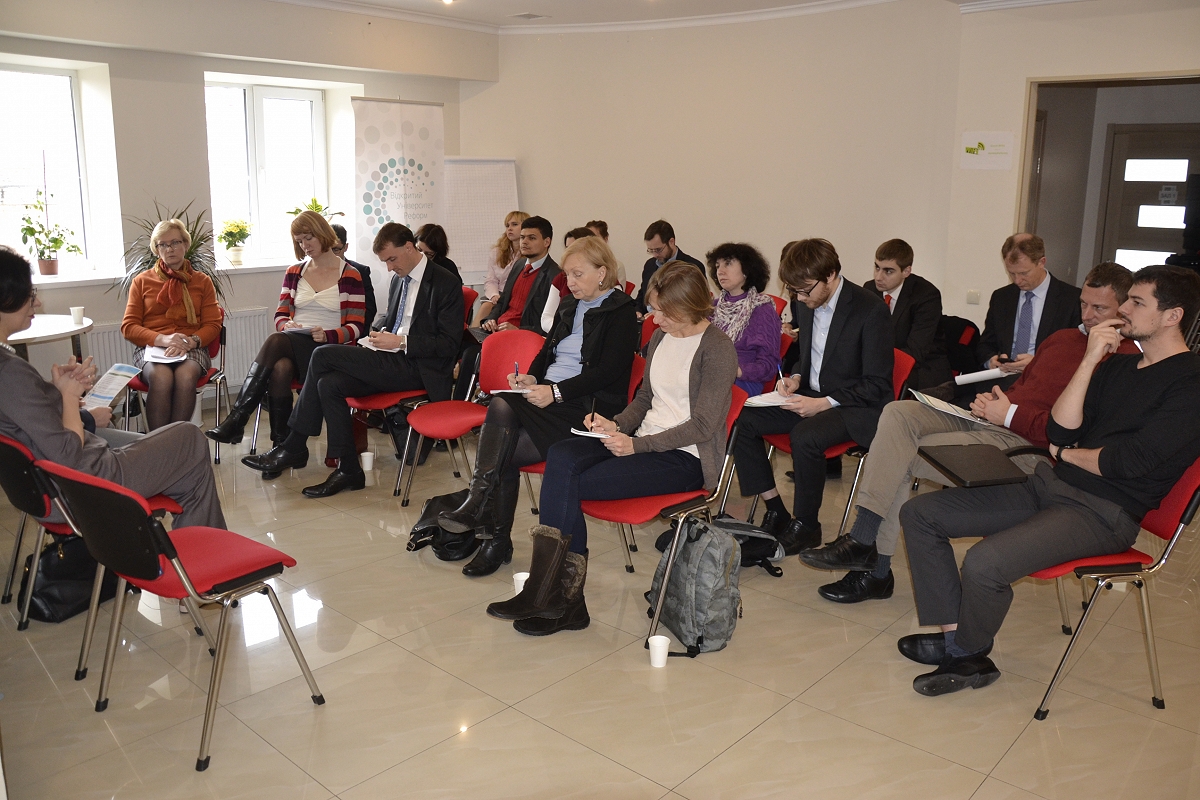
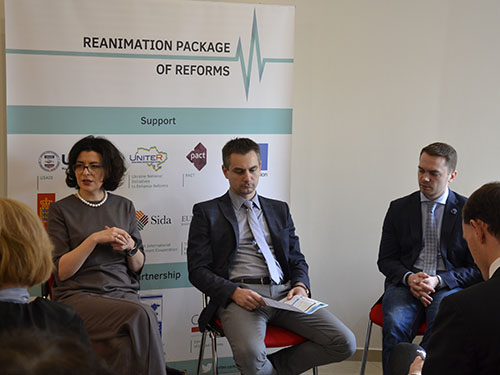
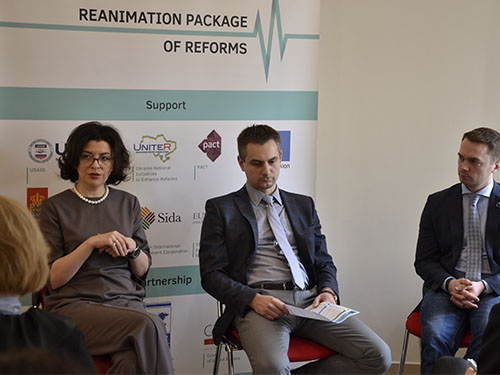
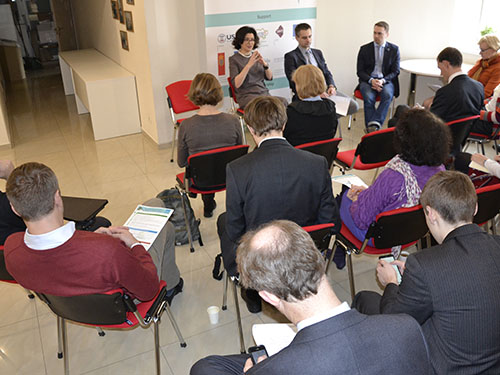
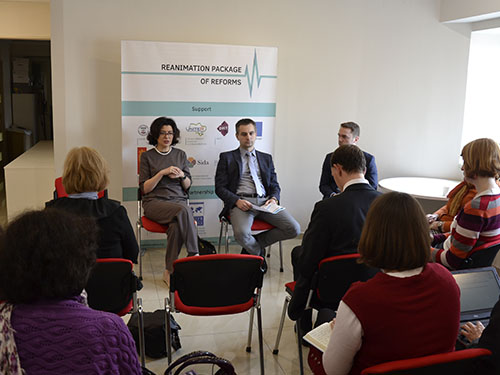
On Friday, December, 4 RPR held a media-breakfast for international journalists, representatives of the embassies and international institutions in order to discuss Constitutional amendments regarding judiciary (hereinafter the “Amendments”) and to point out the view how the reform of judiciary should be implemented.
Distinguished guests of the event were Oksana Syroyid, Vice Speaker of the Verkhovna Rada and Leonid Yemets, First Deputy Chairman of the Verkhovna Rada Committee on Legal Policy and Justice. Reanimation Package of Reforms was represented by Mykhailo Zhernakov, former judge and RPR leading expert on judicial reform and Markiyan Halabala, Deputy Chairman of the Commission on Vetting of Judges and RPR expert on judicial reform.
Commenting on the Amendments, Markiyan Halabala noted that the Amendments have both advantages and disadvantages as every other Law does. At the same time he drew attention to the fact that the provisions regarding attorneys’ monopoly for representation in courts should be removed, as the attorneys are not ready for such responsibility. “Anyway, such attorneys’ monopoly may be prescribed by ordinary Law instead of the provisions of the Constitution”, Mr. Halabala pointed out.
Oksana Syroyid pointed out that the submitted draft of the Amendments is probably the best we had in independent Ukraine. Such Amendments lay grounds for the establishment of the independent and responsible judicial system. However, the Vice Speaker mentioned that it is absolutely necessary to reload the judicial system, and she assumes that the whole process of the reform will be finished within 5 to 7 years after adoption of the Amendments. She also thinks that a Strategic Roadmap on judicial reform should be adopted by the Verkhovna Rada simultaneously with the Amendments showing the bigger picture of the reform and the future steps on its way. This should include positions on how the reform will be implemented, the issues of establishing new courts, judges’ selection process, amending procedural codes, creation of standards for legal profession.
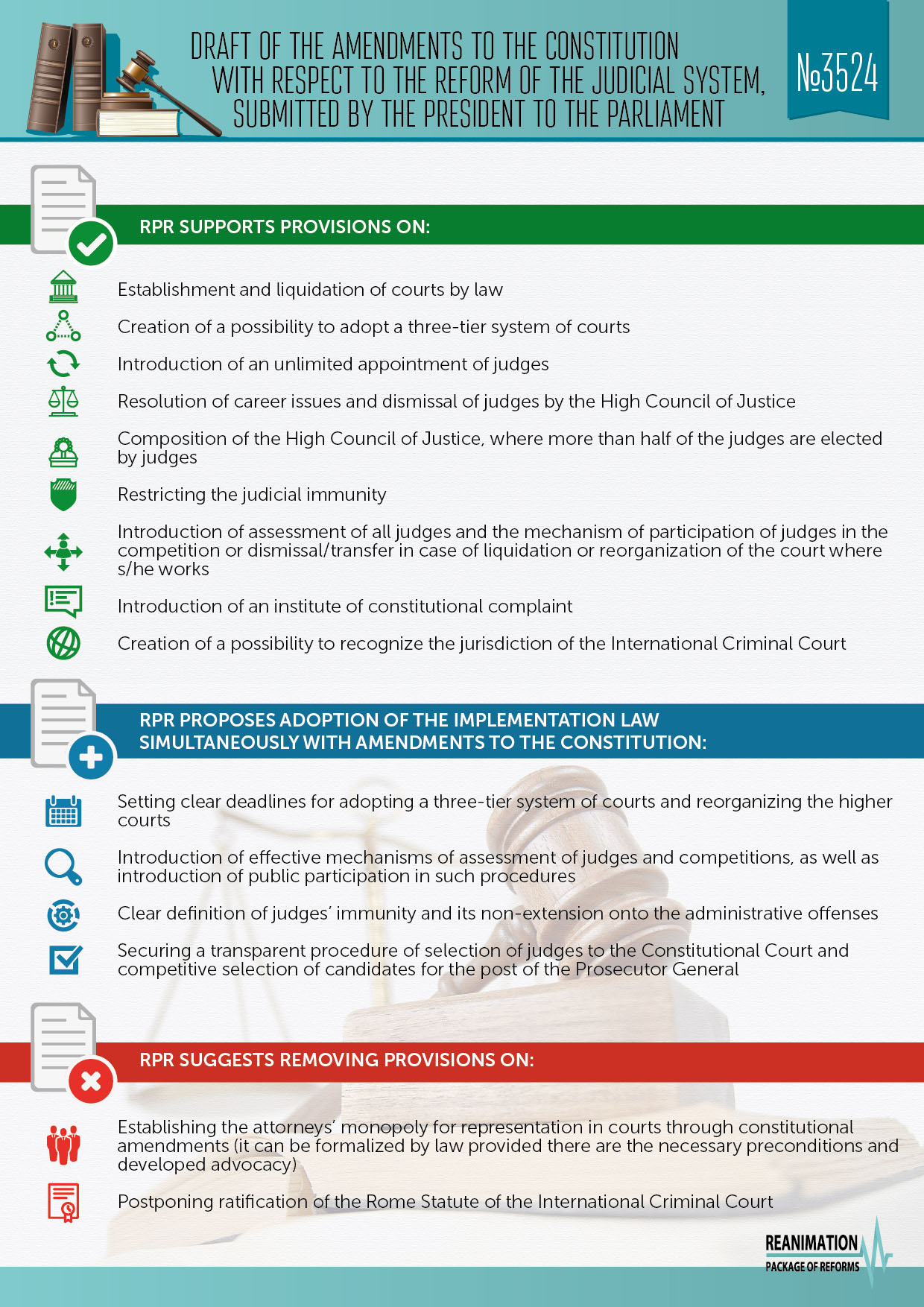
Mr. Yemets was more critical to the Amendments. He pointed out that the courts should be completely reloaded by the constitutional provisions, and judges should be reappointed through a transparent procedure. “Currently, there isn’t any judge who did not take bribe or who did not know about this or was not involved in this in any other manner. Now we have 20000 attorneys, 10000 notaries and dozen thousand of lawyers among which new judges may be selected. Unfortunately, the Amendments provide other way and propose reassessment of existing judges”, he said. In addition, Leonid Yemets mentioned that the Amendments still provide for a four-tier court system where “High Courts may function in accordance with the Law”. “It means, that there may be any such person or institution that may decide whether there should be specialized court or not and respectively to rule it adopting new Laws”, Mr. Yemets stressed.
“In general Amendments correspond with the opinion of the Venice Commission”, Mykhailo Zhernakov said. “It lays ground for the establishment of the independent and responsible judiciary for years to come”. However, the expert points out that the core issue of a judicial reform is the renewal of the judiciary which the constitutional amendments alone do not provide. Therefore, the implementation law stipulating the creation of the new courts and the procedure of transparent competitive based appointment of judges in these courts has to be voted together with the amendments. Integrity, impeccable reputation and proficiency should be the key characteristics of the new judges. “The integrity check is a crucial point. The reload of the judiciary can only be successful if civil society has a dominant role in this process, because the people should trust their judges. RPR experts are now working on this procedure, and we see enough political will among the key decision-makers to make it part of the legislation. However, if such law is not voted together with the constitutional amendments, the reform will not achieve the desired result.”
Other key issue that was raised for the discussion is postponing the ratification of the Rome Statute of the International Criminal Court (the “ICC”) for three years as provided by the proposed amendments. Markiyan Halabala pointed out that this seems illogical as on February 4, 2015 the Verkhovna Rada has adopted the Resolution “On the Declaration of the Verkhovna Rada of Ukraine “On the recognition of the jurisdiction of the ICC over crimes against humanity and war crimes committed by senior officials of the Russian Federation and leaders of terrorist organizations “DNR” and “LNR”, which lead to extremely grave consequences and mass murder of Ukrainian nationals” where it is stated that Ukraine accepts the jurisdiction of the ICC in respect of the crimes mentioned in Declaration starting from 20 February 2014 and to the present time. Although, as it was mentioned by Mr. Yemets, the role of the ICC is not to work instead of Ukrainian courts but rather to guarantee more strict and qualified investigational procedures in Ukraine. Oksana Syroyid mentioned that one possible solution would be to create a hybrid court that would deal with war crimes and crimes against humanity, as well as with grand corruption cases, where Ukrainian judges could consider cases together with the judges from abroad. That, of course, requires more active international cooperation for Ukrainian investigators and the prosecutors.
On Wednesday, December 9, 2015 the Committee of the Verkhovna Rada will consider the Amendments. The RPR will provide its expert opinion on the process as the bill goes through the Parliament.