Reanimation package of reforms > News > Columns > Between Protest and Absenteeism: Reflections on Democracy at the Beginning of 2026
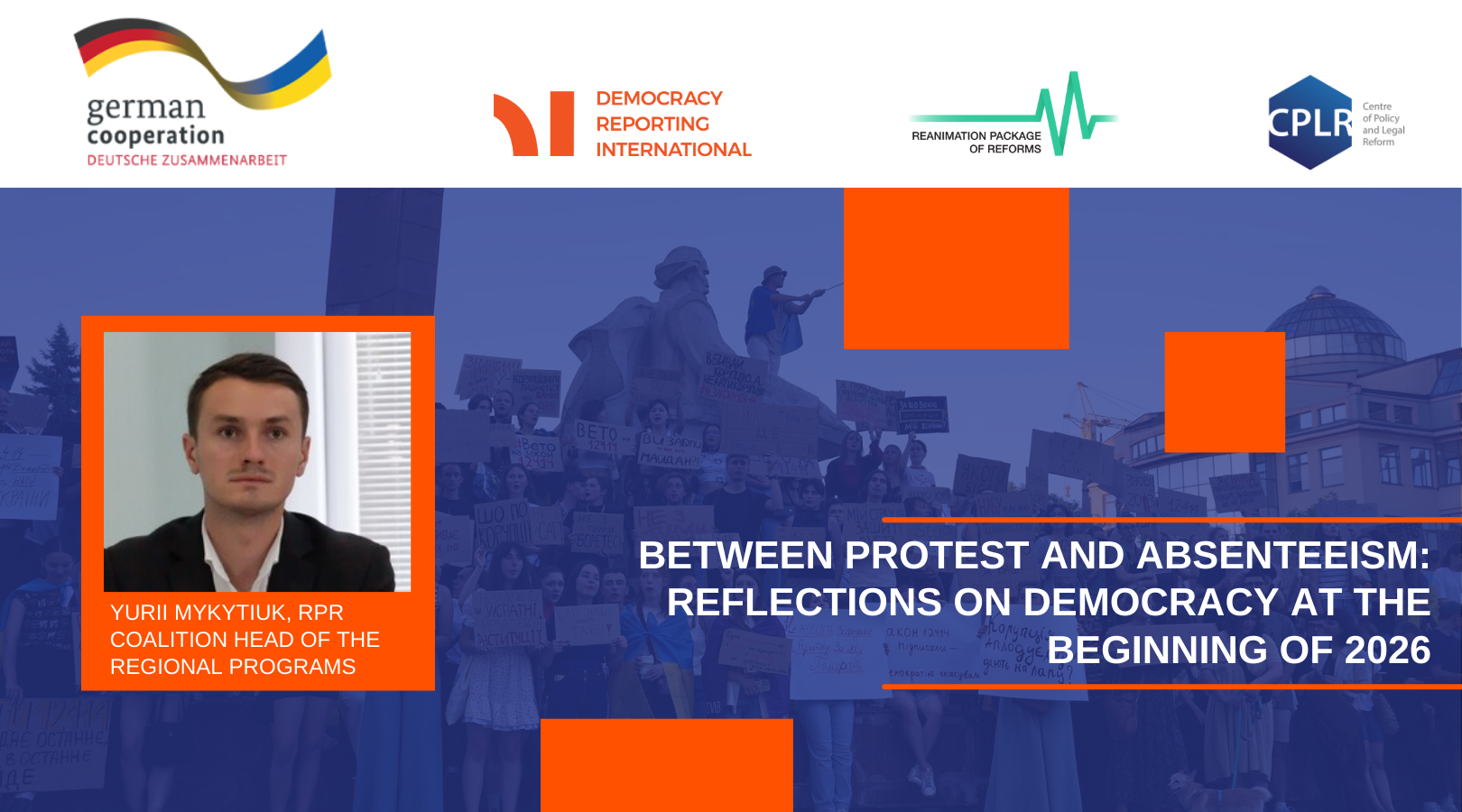
If one were to describe the most effective democratic practice of 2025 in a single word, that word would be protest. In 2023 or 2024, it was difficult to believe that protest actions would become, at the same time, both a catalyst and a symptom of Ukrainian democracy. This is the view of Yurii Mykytiuk, Head of Regional Programs at the RPR Coalition.
Protests were not only an expression of political crisis; they also helped certain institutions to feel their own relevance and importance to society. But what else did Ukrainian democracy bring with it into this year? And will Ukrainians continue to maintain a balance between security and civic awareness? Read more in the column.
Protests were not only an expression of political crisis; they also helped certain institutions to feel their own relevance and importance to society. The story of the “cardboard protest” is one such example. It began as an anti-corruption movement but evolved into something much broader. A sense of justice will continue to fundamentally shape the framework of self-restraint within society.
From 2025 into 2026, we are carrying over the greatest malfunction of democratic mechanisms—an institutional one. The absence of an adequate institutional response reinforces distrust, and distrust, in turn, undermines the capacity of the authorities even in matters that are critically important for survival.
In this context, Ukrainian society is a champion not only in survival and resistance, but also in finding a balance between security and freedom. The search for the right balance is a skill we can share with other European societies. In the West, freedom and security are often perceived as concepts at opposite, often mutually exclusive, poles. Our experience has shown the world that freedom is possible only where there is security—and vice versa.
Therefore, we must strengthen institutional capacity and responsiveness at all levels.
Democracy in 2026 will be defined by three factors: how long the full-scale war will continue, how it will end, and how its outcome will be interpreted by Ukrainians. These factors will shape a new framework for our perception of institutions and will become a new foundation for the post-war social contract—and not only that. To some extent, they will also determine the level of engagement of Ukrainian civil society in building democracy.
Declining civic participation in political life is a universal threat. And if for some this sounds abstract, the example of Russian society—which simultaneously proclaims the so-called “greatness” of the empire and the conviction that nothing depends on the individual—is precisely the scenario we must avoid at all costs. Fatigue will undoubtedly affect us and the pace of our transformation and reforms. And it is precisely now, more than ever, that it is important to maintain the focus of public attention.
We will not be able to return to the reality of before 24 February 2022. Even a formal restoration of old rules and procedures will fill them with a new context of perception and application.
At the same time, we already understand which procedures must be restored as a priority in order not to lose democratic momentum. In particular, in my view, the most important step is the authorities’ withdrawal from the national television marathon. The problem with the marathon is not that it is biased, but that it creates an image that fewer and fewer people trust. Trust within society is our most important social capital. It is trust that will determine how resilient and effective we are, and, consequently, what our future will look like.
Read also reflections on the strength of democracy in 2025 in our special project with Hromadske.
This article was published under the project “Democratic Integration, Resilience, and Engagement” (Ukraine-DARE), implemented by Democracy Reporting International (DRI) in cooperation with the Reanimation Package of Reforms Coalition (RPR) and the Centre of Policy and Legal Reform, with financial support from the Federal Foreign Office of Germany. The views expressed do not necessarily reflect those of the Federal Foreign Office of Germany.


