Reanimation package of reforms > News > Analytics > Are There Alternative Scenarios for Ukraine’s Accession to the EU? UCEP Explains
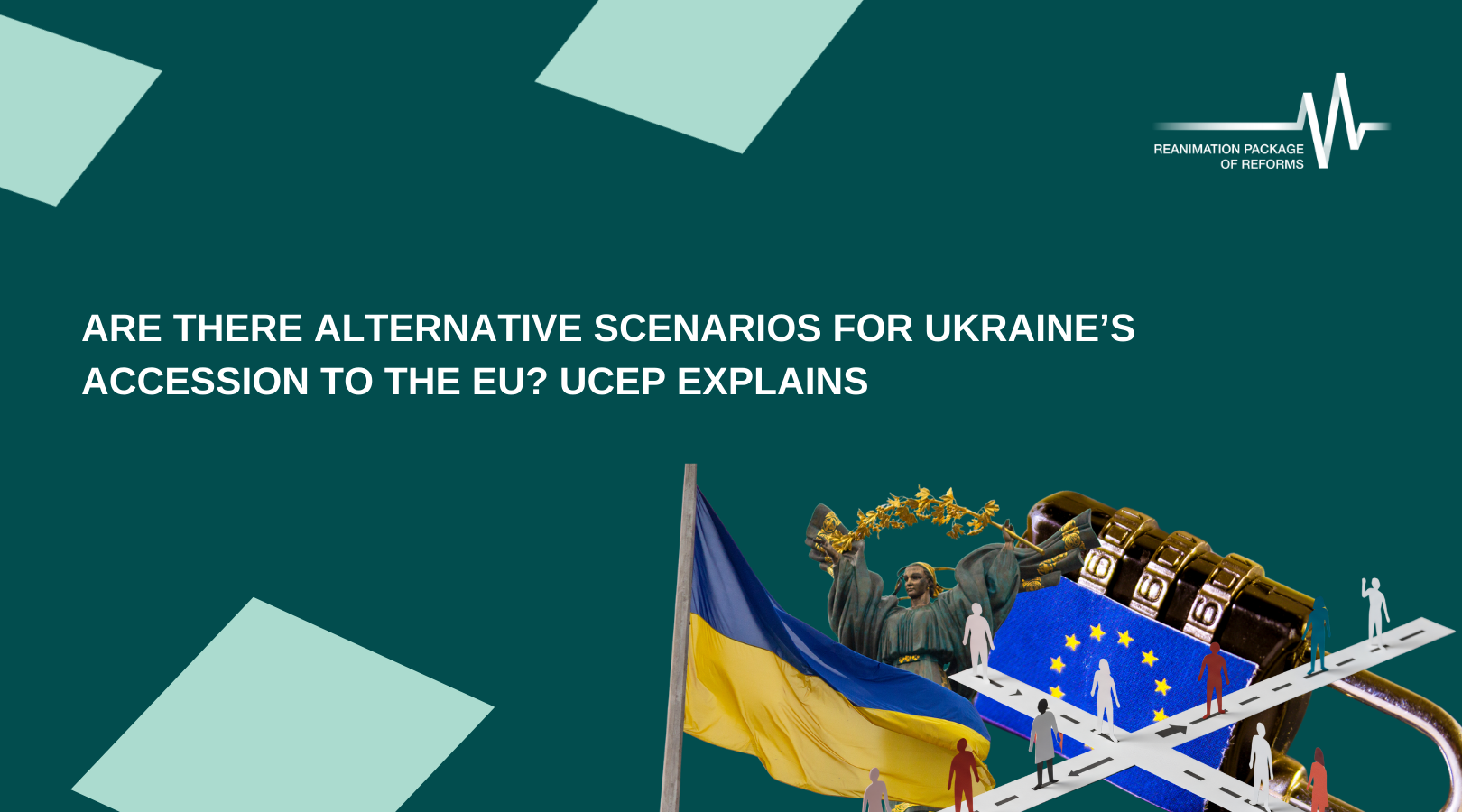
Are there alternative scenarios for Ukraine’s accession to the EU? Recently, the Financial Times covered a discussion on the so-called membership lite—a possibility of faster accession for Ukraine, but with limited rights.
The Ukrainian Centre for European Policy analysed the proposed formats and concluded that the very search for alternative visions of the accession process is a positive signal, as the current accession rules are so complex that their full implementation, even if possible, would take an extremely long time.
At the same time, the question remains how membership lite could be implemented in practice and whether it would ultimately be beneficial for Ukraine. Below we share the Centre’s expert analysis.
For Ukraine, the very fact that alternative visions of the accession process are being explored is a positive signal. UCEP has repeatedly emphasised that the current accession rules are so complex that their full implementation, while theoretically possible, would be extremely time-consuming. The experience of the Western Balkan countries—some of which have been unable to complete the process for more than fifteen years—is indicative.
In this context, two aspects should be highlighted.
EU law, the so-called acquis communautaire, is extremely extensive and continues to expand every year, covering almost all areas of state functioning. To achieve the goal declared by Ukrainian politicians—EU accession by 2030—the adoption of legislation alone would have to take place on a continuous basis. At the same time, problems in the functioning of the Ukrainian parliament do not allow for such an intensive legislative process. In addition, the implementation of EU legislation and the adaptation of businesses and institutions would require significantly more time than just a few years.
Moreover, while Ukraine is adapting its legislation to existing EU acts, new acts are already being developed within the EU to replace them. For example, in autumn 2025, Ukraine began public consultations on a new Customs Code implementing the current Union Customs Code. However, the European Commission has already presented a draft of a new EU Customs Code, some elements of which are expected to be implemented as early as 2028.
The requirement of unanimity in dozens of votes under the current enlargement methodology, combined with the possibility of abusing veto powers, significantly complicates the accession process. For almost a year now, Ukraine has been unable to formally open negotiations under the “Fundamentals” cluster due to blocking by Hungary, despite the fact that all formal requirements have been met.
Ultimately, no country has acceded to the EU under the rules currently in force.
At the same time, in the security dimension, Ukraine is already an extremely important partner for the European Union, making prolonged stay in a “waiting room” politically difficult for the Union—especially given the geopolitical pressure on the EU, as EU accession within peace negotiations is viewed as one of the security guarantees for Ukraine. Therefore, the very fact that the EU is discussing alternative paths for Ukraine’s accession can be considered a positive trend.
The key question is how exactly this would be implemented.
One of the ideas voiced involves limiting Ukraine’s voting rights until all requirements applicable to EU Member States are fully met. However, this raises a number of practical questions. For instance, upon becoming an EU member, Ukraine would be obliged to comply with the Union’s common trade policy, while potentially lacking voting rights when changes to that policy are adopted. If the EU were to conclude a new free trade agreement with a third country, would Ukraine be required to comply with it without having the opportunity to formally support or oppose it?
Another idea envisages Ukraine’s gradual inclusion in certain EU policies and instruments only after formal accession—such as the Common Agricultural Policy or cohesion funds—once specific conditions are met. Here too, questions arise. What happens if Ukraine chooses not to fulfil certain requirements in exchange for foregoing access to the respective funds? For example, if the agricultural sector is not ready to implement the requirements of the European Green Deal, it could remain without subsidies while avoiding burdensome regulation. This would not even require a public declaration—simply not implementing reforms would suffice.
The greatest doubts concern the EU’s political capacity to reach consensus among all Member States on such a radical alternative approach. If the Union has been unable to find a solution to overcome the Hungarian veto even on opening the first negotiation cluster with Ukraine, the question arises as to how it could agree on much deeper changes to enlargement policy.
It appears that reform of enlargement policy must be part of a broader reform of the EU itself, particularly with regard to voting mechanisms and the use of veto powers. If Ukraine’s accession were to take place under an underdeveloped mechanism driven by situational interests, this could create serious challenges both for Ukraine and for the political stability of the European Union itself. Therefore, it would be far more beneficial for Ukraine if alternative accession concepts were discussed within the framework of comprehensive EU reform. It is unlikely that the next wave of enlargement will occur—whether under a simplified or the existing procedure—until the EU decides how it will function with new members and under new geopolitical conditions.
For Ukraine, the normalisation of the discussion on changing the EU accession rules is a positive development, as it signals a gradual shift from a purely formal enlargement approach to a political search for solutions capable of addressing new security and institutional challenges.


