Reanimation package of reforms > News > Columns > Trump Has Awakened Europe. Andriy Lyubka, exclusively for DW
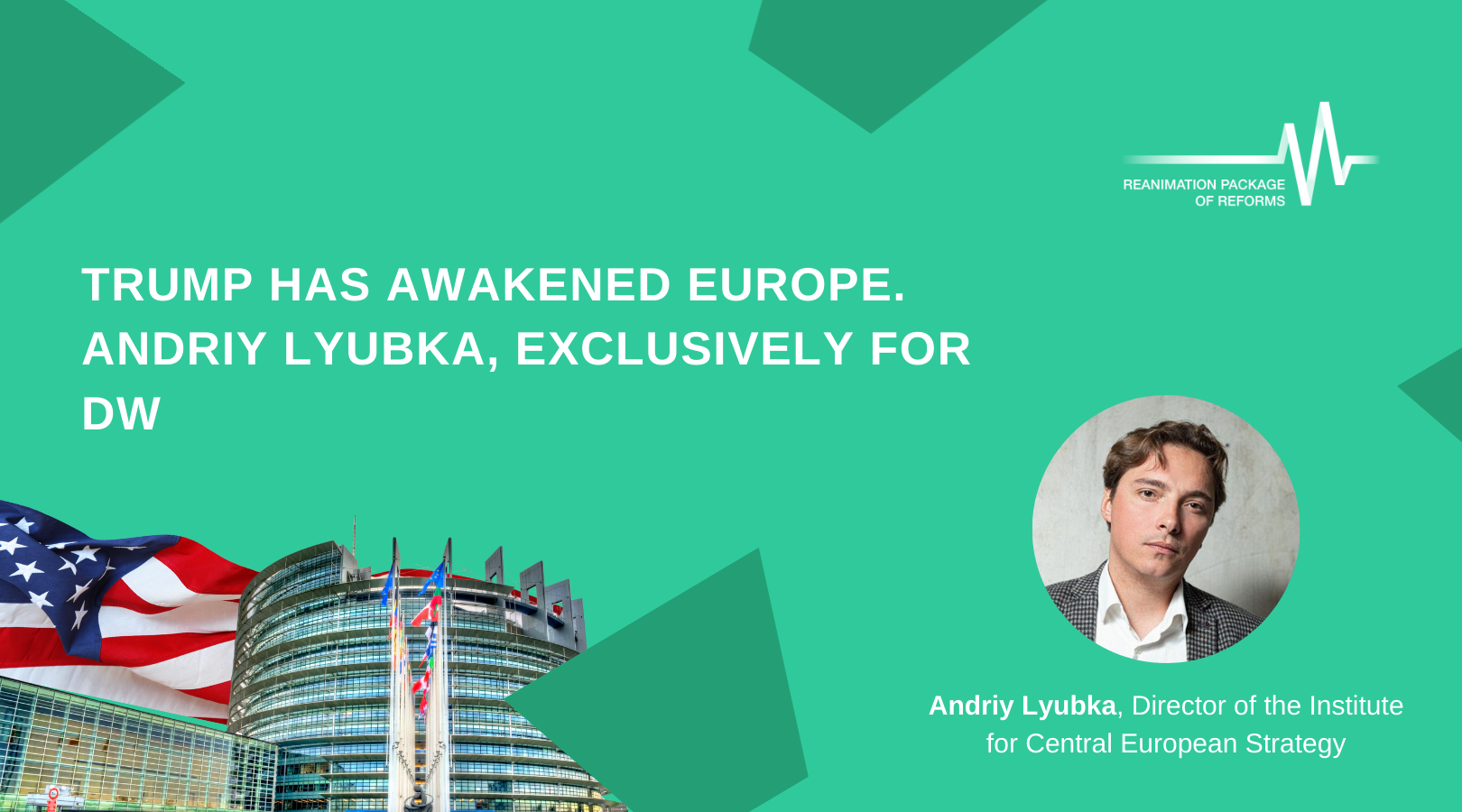
In December 2025, at a closed analytical conference in Germany, an open discussion was held for the first time since the start of Russia’s full-scale invasion of Ukraine about a possible war between Russia and the European Union — and it was not initiated by Ukrainians. Andriy Lyubka, a member of the RPR Coalition Board and Director of the Institute for Central European Strategy, writes about this in his column for Deutsche Welle.
According to Andrii Liubka, Europe’s sudden awakening is linked not to Ukrainian arguments, but to the unpredictability of Donald Trump. Faced with the possible loss of the American security “umbrella,” Europe has begun projecting Russian threats onto itself.
Read the full column on the Deutsche Welle website.
A closed analytical conference in a medieval monastery in rural Germany. Leading European experts are discussing the future of Euro-Atlantic unity in the context of Russia’s war against Ukraine. I am among the audience. At first glance, it seems like an ordinary, routine, and predictable gathering.
However, at this conference, for the first time in the years since Russia invaded Ukraine, I heard a serious discussion about what a war between Russia and the European Union might look like in practice.
Most importantly, the issue was raised not by Ukrainians.
There is a bitter irony in the fact that both the Ukrainian authorities and Ukrainian society have been warning Europe on every possible platform since 2022: this is a war against you as well.
But almost no one listened.
There was sympathy, there was support, but the Ukrainian position was not taken seriously — within the EU it was often seen as a pathos-driven and emotional narrative with little connection to reality.
Ultimately, Ukrainians themselves are hardly in a position to throw stones: before Russia’s full-scale invasion, most Ukrainians also did not believe in a major war or missile strikes on rear cities. On the night of February 24, 2022, Putin jolted us awake by sending a criminal horde into Ukraine and launching deadly missiles at sleeping cities.
For all these years, large-scale war crimes horrified Europeans, yet they still remained merely news stories from another world — something happening to Ukraine because it was not a member of NATO or the EU. The European Union itself, it was believed, was not under threat.
By the end of 2025, however, a different trend has emerged: key experts and politicians in the European Union are seriously discussing possible scenarios of a Russian attack on EU member states — including land and naval operations, as well as hybrid provocations involving “unknown” drones or cyber sabotage.
Unfortunately, this shift in perception is not the result of finally hearing the Ukrainian voice. Europeans have awakened — but they were awakened neither by Ukrainians nor by Russian explosions near EU borders. They were awakened by Donald Trump. His predictably unpredictable behavior and open disdain for the liberal European Union have made it clear over the past year: the security umbrella over Europe no longer exists. And that means Europe must take care of its own security.
Thus, by the end of 2025, we can identify a key change in the European approach to Russian aggression. This is no longer merely a discussion about the war in Ukraine, but about Russia’s aggressiveness through the prism of its war against Ukraine.
At first glance, this may seem like a minor semantic shift, but in reality it fundamentally changes how Putin’s actions and Russia’s strategy are perceived on the continent. Europeans are no longer merely “deeply concerned” about Russian war crimes — they are projecting Russia’s strategy onto vulnerabilities within the EU itself.
The discussions focus primarily on the lack of combat readiness and poor coordination of European armies; the inability to effectively protect European airspace from potential drone attacks from Russia or from “unknown directions”; the absence of sufficient stocks of weapons and technologies relevant to this phase of the war; and the presence of Russia’s “Trojan horses” within the EU. Overall, this represents a comprehensive and rather realistic assessment of the challenges facing a Europe left largely on its own.
If a year ago Europe was seeking security guarantees for Ukraine, by the end of 2025 it is seeking security guarantees for itself. With hopes for American protection uncertain, if not illusory, key European capitals are already thinking seriously about designing a system of European collective security — something akin to a “European NATO.”
However, even with political will, reshaping such a model will take years. For now, the leading EU countries and the United Kingdom are confronted with an obvious fact: today, the only real security guarantee for the European Union is Ukraine and the Ukrainian Armed Forces.
It is Ukraine that is slowing Russia’s aggressive intentions toward Europe by grinding down Russia’s most combat-ready units and undermining the Kremlin’s economic capacity to wage a full-scale war. It is Ukraine that is buying Europe time to rethink, rearm, and prepare. It is Ukraine — and only Ukraine — that can prevent this war from spreading.
For Ukrainians, this conclusion is cautiously optimistic, albeit long overdue. There is no future for European security without Ukraine. And that means there is no future for the European Union without Ukraine. This reality gives Ukrainians grounds to hope for continued financial and military assistance from the EU and for deeper integration with the Union. The realities of war and Trump’s position have made one thing clear: there will be no free Europe without a free Ukraine.
Therefore, Kyiv’s task for the coming year is to convert this European realization into concrete outcomes — funding, military support, and an accelerated EU integration process, on terms most favorable to Ukraine. The time has come for Ukrainian realpolitik.
Originally published on Deutsche Welle


