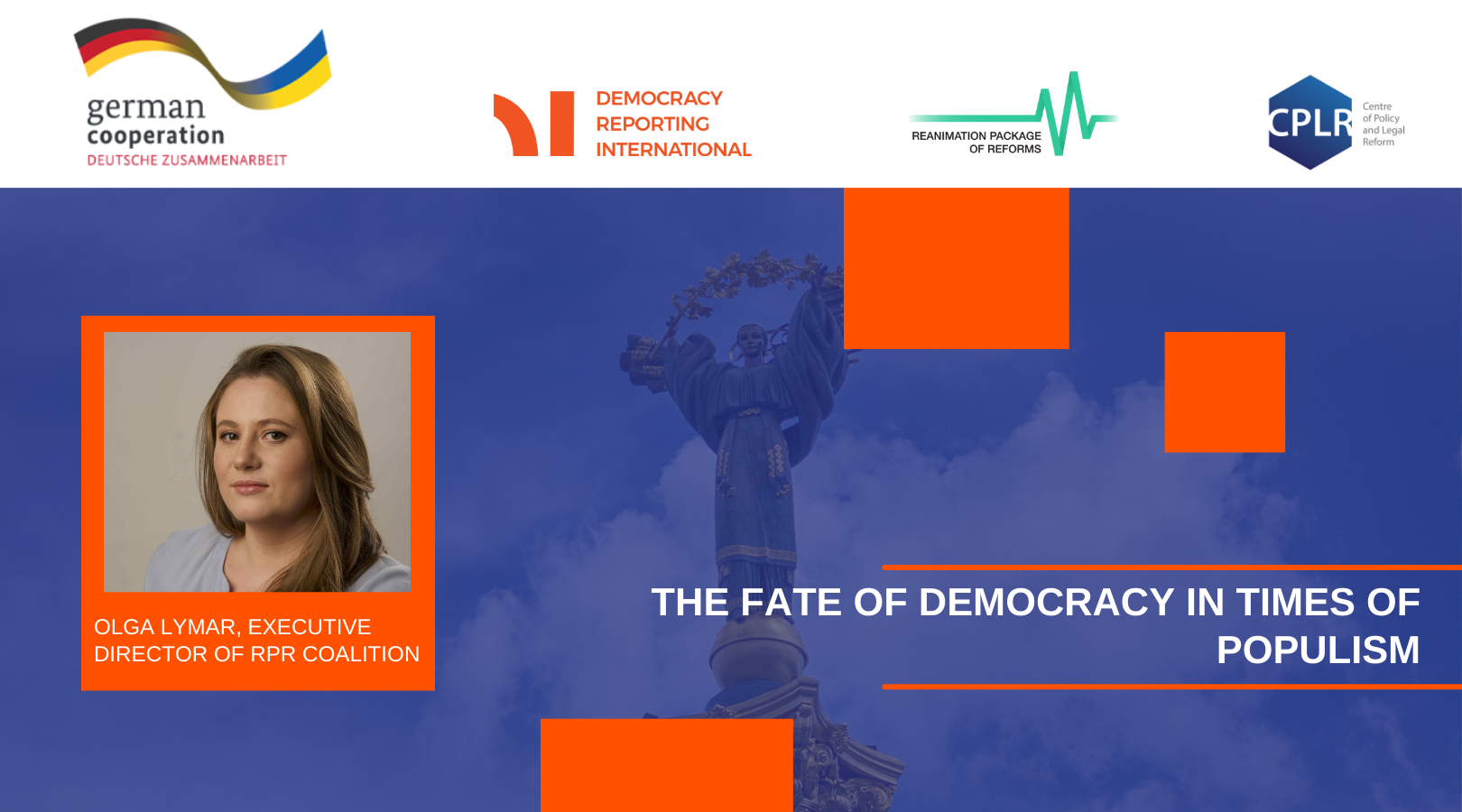
Democracies around the world are losing ground. This is increasingly evident from global political developments and daily news from abroad. After the Revolution of Dignity, we Ukrainians understood the value of a democratic choice like never before. After the start of the full-scale invasion, we are literally giving our lives and safety for democracy — in Ukraine and worldwide. So, does democracy still stand a chance? And can civil society save democratic institutions? The media partner of the Forum “Democracy in Ukraine and the World”, Espreso, exclusively publishes the speech delivered by Olha Lymar, Executive Director of the RPR Coalition, at the event.
After the Revolution of Dignity, we Ukrainians understood the value of a democratic choice like never before. After the start of the full-scale invasion, we are literally giving our lives and safety for democracy in Ukraine and the world. For years, our international partners have supported us as a democratic state. But for how long will we be able to preserve a democratic system during war — under the legislative, technical, and security constraints that make fair, free, and legitimate elections impossible? This is a question of our resilience, cohesion, and clear-headedness.
And for how long will our partners themselves remain democratic? Let’s be honest: there is a noticeable democratic backsliding in the United States. It’s not about a change of ruling party, but about pressure on the media and think tanks, and the erosion of the very demand for strengthening democratic institutions worldwide. The idea that “the more democracies there are in the world, the safer the American continent is” is no longer popular. We see restrictions on freedom of speech in European countries, pressure on civil society, a powerful wave of disinformation, and at the very least, attempts to interfere in elections. It is also possible that radical forces may come to power in the next electoral cycles.
I have more questions than answers. Is there truly a global demand for democracy? Does it reach beyond the so-called “Western bubble” of intellectuals, civil society organizations, and cultural institutions? Will a new social contract be built on democratic values?
Democracy is not always an end in itself. Often, it is a tool — even a process. We have simply not invented anything better. In any struggle, including the struggle for democracy, a key question emerges: for which value am I fighting? Is it more important than others? Must Europe — with its developed culture of consumption and comfort — sacrifice this comfort to support a still-democratic Ukraine in its fight against authoritarianism?
Recalling Václav Havel, who wrote about the “power of the powerless,” I ask myself: who is powerful now? Are tyrannies powerful? Are democracies powerful? Or is the true force in disappointment — or in faith in something else?
We must already start thinking about why the democracy we knew in recent decades is weakening. What is essential for it — and what is not.
Democracy has actually provided many tools that enabled leaders with autocratic ambitions to come to power. The media — one of the pillars of democracy — has at times become an instrument of manipulation. It is used, particularly in the U.S. during the latest elections. And not always through illegal means — sometimes simply by exploiting existing systems. Among EU countries, perhaps the least democratic is Hungary, where freedom of speech and civil society are in a far worse condition than in Ukraine under martial law. Yet it was precisely through democratic mechanisms that Hungarian society brought a rather autocratic leader to power. Modern democracy can therefore be used to the advantage of autocracy.
Is democracy a factor of security?
If we speak strictly about the military sphere, the war will provide the final answer. I do not know whether the Russian authoritarian machine is more effective. Only the military can answer that.
But if we return to the human dimension: autocracies are always dangerous. Your rights, your existence, your right to say “no” are constantly under threat and surveillance. Certain infantile and irresponsible desires for easy solutions in many countries encourage authoritarian ambitions. The demand for a strong leader instead of strong institutions inevitably leads to danger. Autocracies can never be safe by definition.
Without democracy, our most fundamental right — the right to life — is at risk. Without safeguarding other rights, including civil and political rights, we may simply lose the right to live. Our rights have meaning only when someone speaks about them — and invariably defends and protects them.
Returning to the RPR Coalition and civil society organizations: many strong Ukrainian CSOs and think tanks were born of our revolutions. The RPR Coalition is a unique phenomenon — a mix of highly motivated people and a professional approach to policymaking.
And as the world changes, and Ukraine changes, the demand for our work also changes: we speak less about systemic reforms, long-term solutions, and democratic preservation — and more about short-term results and rapid fixes. These can be useful, but they cannot replace the foundations. Populism — which I see as infantile and irresponsible — is entering the civil sector as well. How well we adapt to new conditions and preserve the demand for democracy will determine the strength of our influence in these turbulent times: a time of war for Ukraine, a time of populism for the world, and a time of confrontation with autocracies. Civil society organizations, in their cohesion and ability to cooperate, can still address the weaknesses of democracy: how to strengthen our media, how to improve procedures, how to make policymaking more effective.
In an era of populism and blurred critical thinking, civil society can still bring democracy back to its essence — even if some methods change. We need not only strong public institutions, but also strong civil society institutions.
Should we try to persuade and motivate society, each other, ourselves — even when we want to give up? The answer is both yes and no. We must work with disillusionment and populism, but also remind ourselves of things for which motivation is difficult — perhaps even impossible.
Motivating someone to love their state. Motivating them to strive for freedom, knowing that freedom also means certain constraints.
I’m not sure you can teach an adult these things — they are rooted deep in a nation’s code. This, in fact, is our hidden advantage over Russia. We already have this motivation. It has been nurtured for centuries — to live, to be free, to be democratic, to persevere toward victory.
And I am convinced that this motivation is the unifying force capable of overcoming the weaknesses of procedures, institutions, or the pain of democracy’s failures.
This article was published under the project “Democratic Integration, Resilience, and Engagement” (Ukraine-DARE), implemented by Democracy Reporting International (DRI) in cooperation with the Reanimation Package of Reforms Coalition (RPR) and the Centre of Policy and Legal Reform, with financial support from the Federal Foreign Office of Germany. The views expressed do not necessarily reflect those of the Federal Foreign Office of Germany.


