Reanimation package of reforms > News > Analytics > The Verkhovna Rada adopted the Law “On the Military Ombudsman”
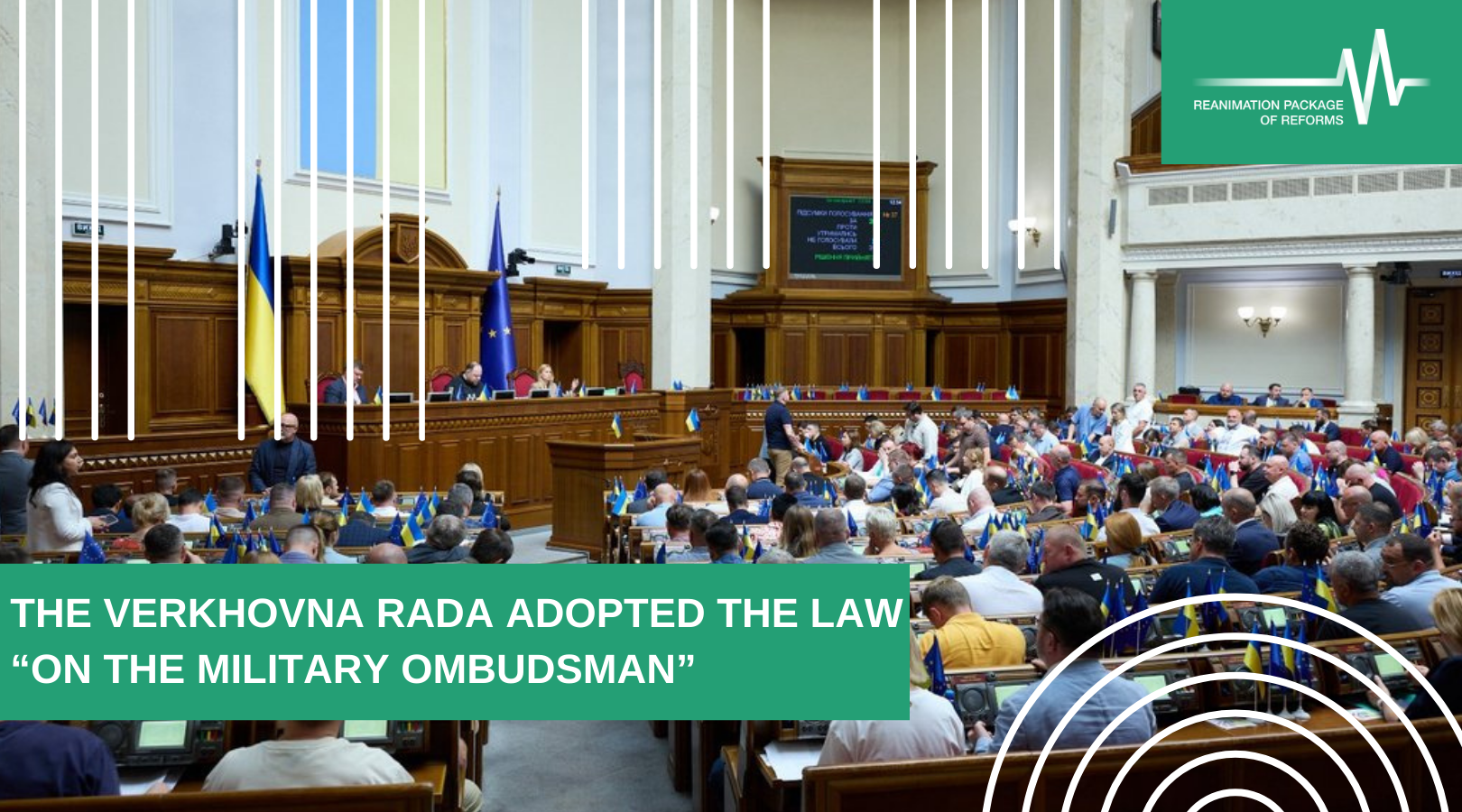
On September 17, the Law of Ukraine “On the Military Ombudsman” was adopted. On September 19, the President of Ukraine issued a decree approving the Regulations “On the Office of the Military Ombudsman” (registration No. 691/2025), which sets out the procedures for the work of this auxiliary body. Experts from the Center for Political and Legal Reforms participated in the preparation of this draft law, but none of their proposals were taken into account. After the adoption of the Law, they conducted a thorough analysis of its provisions. The experts focused primarily on the shortcomings of the new institution that could hinder the effective protection of the rights of military personnel.
1. In its political analysis, the Center for Political and Legal Reforms has already noted the risk of the Law being unconstitutional. The Constitution of Ukraine exhaustively defines the powers of the President of Ukraine, including those related to personnel issues. However, the Constitution does not include the power to appoint and dismiss the Military Ombudsman, which also raises questions about the independence of this body.
A more effective way to strengthen the protection of the rights and freedoms of military personnel would be to define the institution of the Military Ombudsman as part of an already effective mechanism, namely, in the Law “On the Ukrainian Parliament Commissioner for Human Rights” – as one of the representatives of the Commissioner, possibly with certain special sectoral powers.
2. The Military Ombudsman has a fairly broad range of powers. These powers (to consider complaints and conduct inspections, request and receive information, etc.) could, under certain conditions, really help military personnel defend their rights. At the same time, the law is full of evaluative concepts. This hinders its effective implementation and clear understanding of its provisions, creates risks of abuse, delays the complaint review process, and violates the principle of legal certainty.
The military ombudsman was created as an additional body to respond more quickly to violations of the rights of military personnel. However, the time required to consider a complaint, conduct an investigation, prepare a conclusion, and have it reviewed by a commander can take four months (10 working days to consider the complaint + 60 working days to conduct the investigation + 30 working days to review the conclusion) or even longer (taking into account the time required to send documents, weekends, holidays, etc.).
The presence of the phrases “reasonable grounds” or the submission of a “reasonable request” (Part 4 of Article 17, Part 4 of Article 18 of the Law) is not a valid reason for extending the deadline. Specific circumstances under which the relevant deadlines may be extended, as well as cases in which these deadlines should be shortened, must be defined. The Law does not provide for liability for violation of the deadlines for consideration.
3. The Law does not propose to define: the deadline for filing a complaint and the consequences of its violation; the rights of a person during the consideration of their complaint; the procedure for registering a complaint and its progress; the duties of the Military Ombudsman and his authorized persons when considering a complaint; compensation for damages in connection with a violation of the requirements of the Law during the consideration of a complaint, and other issues (by analogy) that are specified in detail in the laws “On Citizens’ Appeals” and “On Administrative Procedure.”
4. The law does not clearly define in which cases military personnel should file a complaint in accordance with the procedure provided for by this law, and in which cases they should do so in accordance with the procedure provided for by the Disciplinary Statute of the Armed Forces of Ukraine. In particular, the procedure for submitting complaints by military personnel is provided for in paragraphs 110-111 of the Disciplinary Statute of the Armed Forces of Ukraine.
5. The law does not explicitly define the ombudsman’s powers to freely visit and stay at Territorial Recruitment and Social Support Centers (paragraph 6 of part 1 of Article 9 of the Law). This would be appropriate, given a number of high-profile situations related to TRSCs that are known from open sources.


