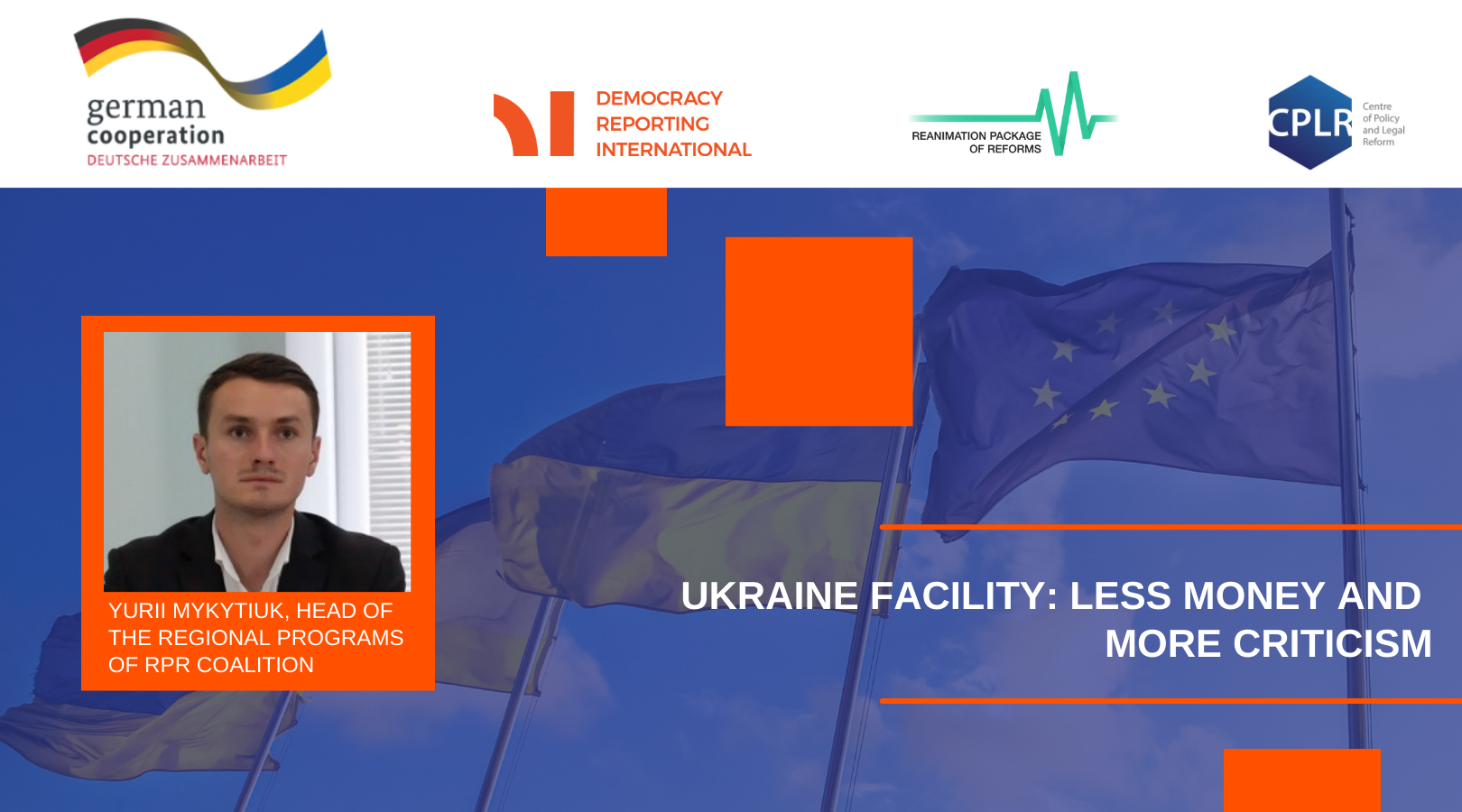
This is the current state and dynamic of Ukraine’s implementation of the Ukraine Facility Plan.
On 28 February 2024, the Council of the European Union approved the launch of the Ukraine Facility with a total volume of €50 billion for 2024–2027. For the second year now, the Ukraine Facility has been the foundation of our EU funding.
The government’s website defines the Ukraine Facility as “a technical document necessary for implementing the EU’s financial support program for Ukraine. The Plan envisages reforms that will lay the foundation for the further recovery and development of the economy and Ukraine’s integration into the EU.” Although the document is indeed technical in its form and structure, the reforms within it are divided into three main groups:
Basic reforms (public administration, public finance management, the judiciary, anti-corruption)
Economic reforms (financial markets, business environment, state asset management, decentralization and regional policy)
Key sectors (energy, transport, agri-food sector, digital transformation, green transition and environmental protection)
However, the Ukraine Facility is deeply political in nature. This was already clear in February 2024 but has been formally confirmed in recent months, as Ukraine began to stall in implementing the Plan, and in July this year the EU financially penalized us for delays in reforms.
On 23 July, the Committee of Permanent Representatives (Coreper) approved the fourth tranche of financial assistance under the Ukraine Facility worth €3.05 billion. While this is a significant amount, European Pravda reported that the tranche Ukraine received was €1.5 billion less than planned (€4.05 billion). Although Ukraine has not permanently lost this €1.5 billion — it was withheld in July due to the lack of reforms — this is no cause for comfort, as the trend toward slowing down, and in some cases reversing, reforms is becoming increasingly clear, while the need for EU funds only grows.
It is positive that society mobilized in time and pressured the authorities to restore the institutional independence of the anti-corruption infrastructure. However, this cannot be a permanent mechanism for saving Ukraine’s image (and replenishing the budget). The new Government must offer a better level of communication with Members of Parliament and civil society experts. Only then can we speak of progress in reforms which, ironically, are needed not by officials in Brussels but by Ukraine itself. The first test of effectiveness will be the vote on the reform of local state administrations — part of the unmet Ukraine Facility requirements that has been under discussion in the Verkhovna Rada for over five years.
The implementation (or non-implementation) of the Ukraine Facility is about critically needed funds for a country at war, but it is also about our image in the EU. We can position ourselves either as a country capable of honoring commitments and implementing systemic reforms, or as an unstable and unpredictable partner. There is a big difference between “the EU will never abandon us no matter what” and “Ukraine is confidently moving toward the EU” — a difference the Ukrainian authorities, I hope, understand.
Yurii Mykytiuk, Head of Regional Programs, Reanimation Package of Reforms Coalition
This material was published within the project “Democratic Integration, Resilience, and Engagement” (Ukraine-DARE), implemented by Democracy Reporting International (DRI) in cooperation with the Reanimation Package of Reforms Coalition and the Centre of Policy and Legal Reform, with financial support from the Federal Foreign Office of Germany. The project aims to promote the alignment of Ukrainian legislation with European Union norms, foster dialogue on the challenges to democracy in Ukraine during the war, and encourage youth civic engagement. The views and opinions expressed in the material do not necessarily reflect those of the Federal Foreign Office of Germany.


