Reanimation package of reforms > News > Longreads > Defense and European Integration: Key Insights from URC 2025
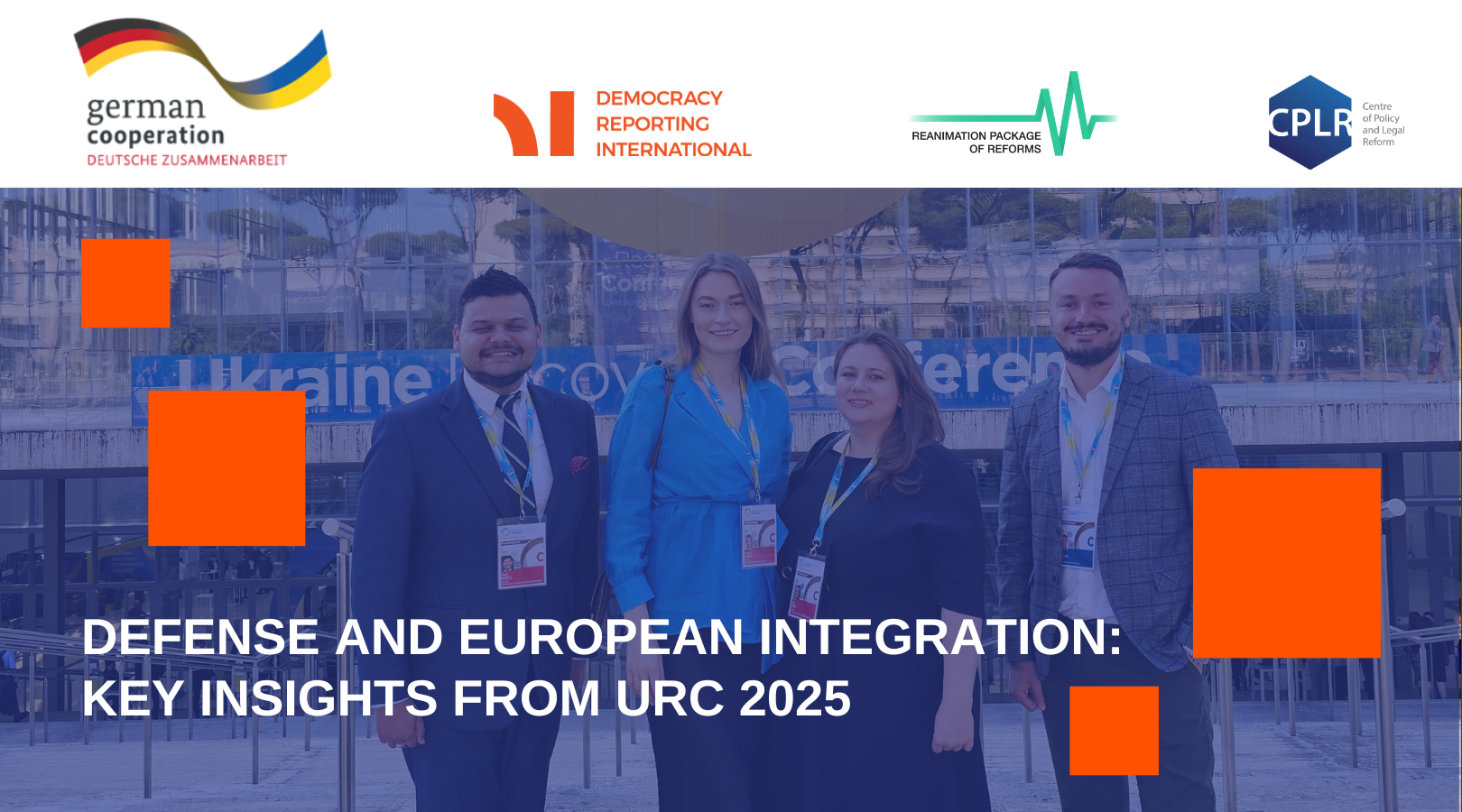
Last week, the Ukraine Recovery Conference 2025 (URC 2025) concluded in Rome. This is the largest intergovernmental forum on Ukraine’s recovery, reconstruction, and reform, held annually since the beginning of the full-scale invasion and continuing the legacy of the Ukraine Reform Conferences. This year, the Italian government served as Ukraine’s official partner.
“We want to stop the darkness. We want to build a strong future,” stated Italian Prime Minister Giorgia Meloni. She emphasized that investing in Ukraine means investing in the security of European citizens, and everything rebuilt in Ukraine will be part of a broader European cultural space.
The conference brings together a wide range of issues and stakeholders — government representatives from Ukraine and abroad, businesses, civil society, cultural leaders, philanthropists, diplomats, the media, and more. Each year, few key messages tend to emerge during plenary sessions.
So, what were the main messages that Ukraine’s leadership and civil society took home from this year’s Conference? In this piece, URC 2025 participant and Executive Director of the RPR Coalition, Olga Lymar, shares her perspective.
Continued Support for Ukraine: Light Against Darkness
“Our solidarity with Ukraine is on all fronts: military, financial, and political,” opened Ursula von der Leyen, President of the European Commission. In my view, one of the key takeaways from the Conference was her announcement of the launch of the European Flagship Fund for the Reconstruction of Ukraine — supported by the European Commission, Italy, Poland, France, Germany, the European Investment Bank, and potentially other partners. It will be the largest recovery fund for Ukraine to date.
This message is undeniably important for Ukraine: it speaks not only to our ability to recover from the consequences of Russia’s war but also to our ability to resist aggression. Still, in the fourth year of full-scale war, I had personally hoped for stronger declarations — especially given the waning support from the U.S. and delays in opening EU accession negotiation clusters.
Defense Investment Mentioned for the First Time at URC
From my perspective — and the opinion of many I spoke with at the Conference — the strongest speech came from German Chancellor Friedrich Merz. He openly named Slovakia as the country blocking a new package of anti-Russian sanctions. Speaking directly to Putin, Merz declared that “we will not back down,” and called on the U.S. to stand with Germany and Europe. As a practical step, he confirmed Germany’s purchase of defense equipment from the U.S. for Ukraine.
This year marked the first time that the defense sector was formally represented at the Conference.
A number of announcements centered on security. EU Commissioner for Defense and Space, Andrius Kubilius, announced the creation of Brave Tech European Union — a €100 million tech alliance between Ukraine and the EU.
This reminded me of Commissioner Kubilius’s response to a question I asked a month ago at the Brussels Forum hosted by the German Marshall Fund. He said, “Ukraine’s accession to the EU is now more beneficial to the Union itself than to Ukraine.” I believe this speaks to both the EU’s expansion to include democratic states and its investment in European security. Ukraine today is where democracy, security, and EU enlargement converge.
Polish Prime Minister Donald Tusk, whose country will host URC 2026, emphasized that Ukraine’s recovery is impossible without victory: “Ukraine’s victory is the victory of our values and of collective security.”
President Volodymyr Zelenskyy once again referenced the idea of a Marshall Plan for Ukraine, which gained traction in the first year of the full-scale invasion. Initially, this plan evolved into various support programs, including the Ukraine Facility — but now it’s about creating a full-fledged Coalition for Ukraine’s Recovery.
Opening the First EU Negotiation Cluster — Will It Happen This Year?
While not the most high-profile topic of the Conference, one issue of profound importance was the opening of the first of six EU accession negotiation clusters. This first cluster — which opens the talks and closes them — is rightly called Fundamentals because it defines the country’s democratic trajectory, its rule of law, its economic governance, and its human rights standards.
From the main stage of URC 2025, Ursula von der Leyen once again reaffirmed the European Commission’s full support for opening this cluster for Ukraine. Chancellor Merz added: “We fully support Ukraine on its path to European integration.”
We asked Enlargement Commissioner Marta Kos what can be done right now to prepare for opening the first cluster — and how the enlargement process could be reformed to prevent deadlocks, like Hungary’s effective veto under Prime Minister Orbán.
The Commissioner raised the stakes in her reply: she not only reaffirmed her commitment to completing this wave of EU enlargement by the end of her term in 2029, but also promised that all six negotiation clusters for Ukraine would be opened by the end of this year.
She also praised the role of civil society, specifically referencing the recent statement initiated by the Ukrainian Centre for European Policy, the Centre of Policy and Legal Reform, and the RPR Coalition — and supported by dozens of civil society organizations — calling for the opening of the first cluster. She emphasized that Hungary will not be able to block the process.
We can only hope that behind Commissioner Kos’s ambitious words lies a practical understanding of how to turn this vision into reality.
In Summary
This Conference once again underscored the links between reform and democracy, EU enlargement and European security. Ukraine is undoubtedly the cornerstone of this security. It’s encouraging to see this understanding grow — not only in Ukraine, where the strongest army in Europe is fighting — but also within the EU itself. It’s crucial that this awareness spreads beyond the political elite and reaches the electorate, to whom European leaders are ultimately accountable — unlike in authoritarian regimes.
Security concerns force politicians to balance immediate public opinion with an understanding of long-term consequences. When enemy drones and missiles begin to strike your cities, support for security initiatives tends to “suddenly” increase.
A Ukraine integrated into the European Union is a key component of a secure and democratic Europe. For me, the opening of the first negotiation cluster remains a top priority in the reform agenda.
At a side event at URC 2025, I heard an EU representative say that either unanimity or creative solutions are needed to move forward. I believe that now — after the expected June opening of the first cluster didn’t happen — it’s time to apply that creative thinking.
And maybe it’s not just about creativity, but also about courage — and understanding the consequences of action or inaction. So there is hope that the optimism voiced at the Conference will soon turn into concrete decisions.
The material was published within the framework of the project “Democratic Integration, Resilience, and Engagement” (Ukraine-DARE), implemented by Democracy Reporting International (DRI) in cooperation with the Reanimation Package of Reforms Coalition and the Center of Policy and Legal Reforms with the financial support of the Federal Foreign Office of Germany. The project aims to facilitate the approximation of Ukrainian legislation to the EU norms, build a dialogue on the challenges to democracy in Ukraine during the war, and promote civic engagement of young people. The opinions and views expressed in this material do not necessarily reflect the position of the Federal Foreign Office of Germany.


