Reanimation package of reforms > News > Columns > From decommunization to decolonization – the reform of national memory policy today
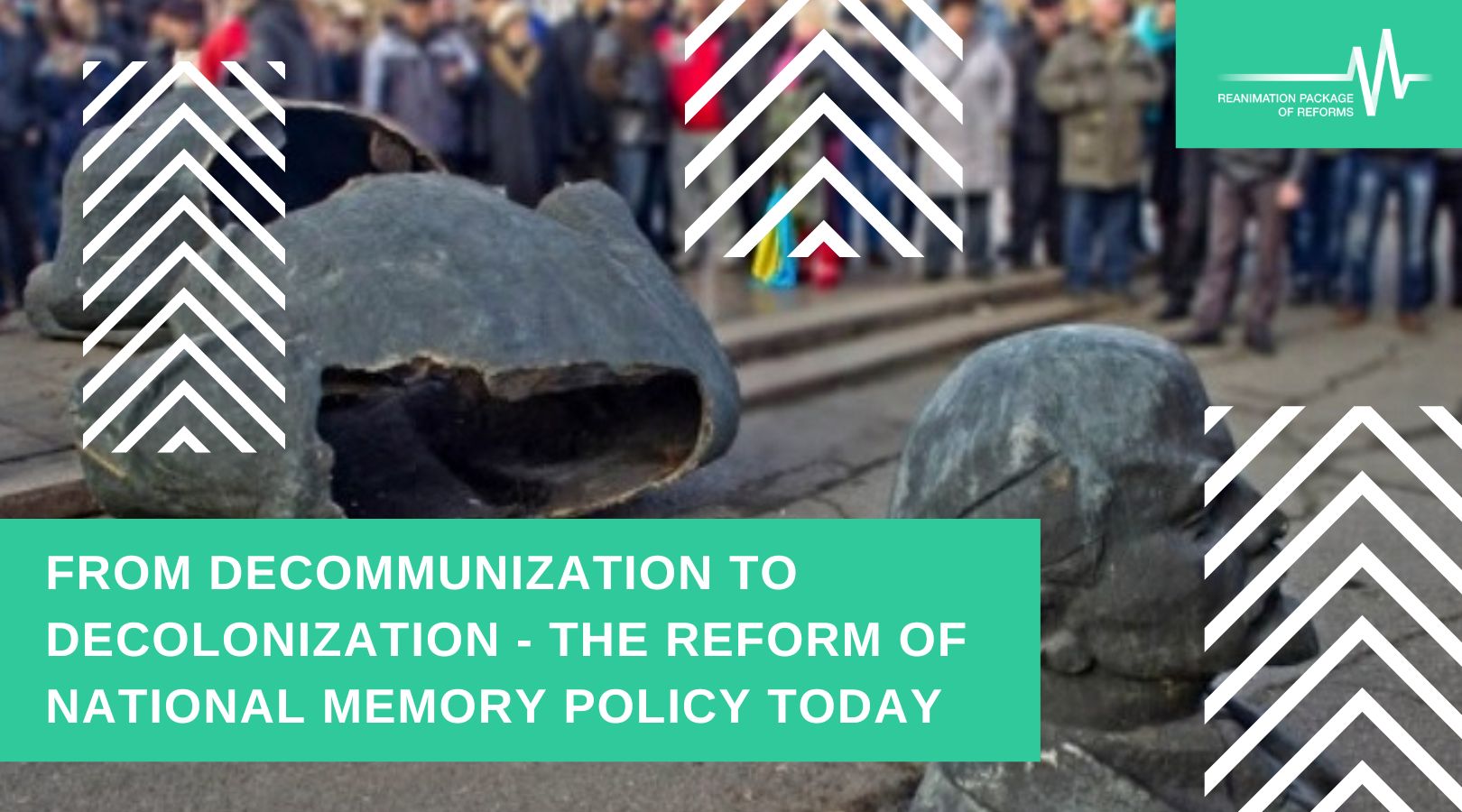
10 years ago, the Verkhovna Rada of Ukraine adopted a package of laws that resulted in the cleansing of public space from totalitarian symbols, a move away from the Soviet past, and its reinterpretation.
The rethinking of the communist heritage began long before the Revolution of Dignity, but it was 10 years ago, after the adoption of the Law of Ukraine “On the Protection of the Public Space” on April 9, 2015. Law of Ukraine No. 317-VIII “On the Condemnation of the Communist and National Socialist (Nazi) Totalitarian Regimes and the Prohibition of Propaganda of Their Symbols” – a systematic process of decommunization reform began.
The process of decommunization is not just about renaming streets or demolishing monuments. It is a broader process of decolonization of the Ukrainian space, of reclaiming our own history. And this process is still ongoing. We asked Yaryna Yasynevych, a member of the RPR Coalition Board and the Board of the Center for Liberation Movement Studies, what are the key challenges facing the decommunization process today.
First of all, it is worth mentioning what the reform of the national memory policy envisaged, in particular, such key elements as
Eleven years after the reform began, 10 years after the parliament passed a package of decommunization laws, on the 12th year of the war for independence, much of what was planned has been implemented.
The key challenges today are the need to complete the reform of access to archives, namely the physical transfer of archival documents currently under the jurisdiction of the special services to a civilian agency. This will not only ensure the sustainability of free access to these materials, but will also relieve Ukraine’s democratic special services and law enforcement agencies of their uncharacteristic functions of document preservation and potential control over historical information.
Today, we need a framework law that will lay a stable foundation for the state policy of national memory, which would set out the key goals of such a policy, describe the powers between the authorities, and record the state’s readiness to provide the necessary resources for this policy.
In addition, the parliament has not yet adopted a number of resolutions prepared with the UINP on renaming cities and villages as part of decolonization – the law on this was adopted in 2023.
The framework law on the calendar of public holidays and memorial days has not yet been adopted, although the policy for their determination is mostly structured. However, the law will create a stable framework, thus contributing to the sustainability and logical complement of the State Calendar of Holidays, and thus identifying key events for a democratic country that should be commemorated at the national level.
The creation of the National Military Memorial Cemetery has begun, but key decisions on its appearance and location have been made behind the scenes without proper civil dialogue. The challenge remains to create a truly worthy visual, aesthetic, and ethical object of memory of the heroes for us and future generations.
Finally, the creation of the National Pantheon of Heroes has been effectively suspended, not because of the circumstances of the full-scale invasion, but because of the reluctance of a number of government officials to engage in a frank dialogue about honoring the figures of the past, especially those who are still under the influence of Russian propaganda.
Thus, we can see that the process of decommunization and decolonization is still ongoing. The RPR Coalition, including experts from the Center for Liberation Movement Studies, are working to ensure that the reform does not slow down.


