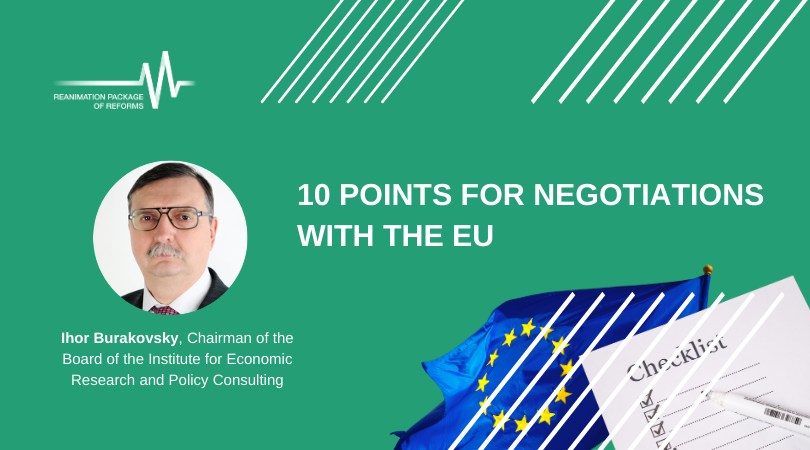
For the first time in the history of the EU, a country at war will join the Union. However, this does not mean any relaxation for us. Ihor Burakovsky, Chairman of the Board of the Institute for Economic Research and Policy Consulting, analyzed the results of the conference “Strategic Partnership: Deepening Polish-Ukrainian Relations in the European Context”. He identified 11 points of conclusion that Ukraine needs to keep in mind on its way to the European Union. The first of them we have outlined above: concessions should not be expected because of a full-scale war. What are the other 10? We discuss them below.
- Negotiations on EU accession will be very difficult from a purely technical point of view. The EU’s negotiating team will be made up of professionals who come from the EU, while the Ukrainian team and government officials will have to learn a lot in the process.
- The experience of past enlargements and related negotiations is of limited value to Ukraine given the changes that have taken place in the world and in the EU since then. Moreover, the EU itself is facing the challenge of its own transformation.
- The challenge for Ukraine is to ensure that the process of gaining EU membership today becomes a factor in ensuring Ukraine’s economic sustainability and then a driver of economic recovery tomorrow.
- Membership negotiations are a school of finding mutually acceptable compromises to resolve controversial issues, especially in relations with individual EU member states. These lessons will be useful when Ukraine becomes a member of the EU.
- Regarding current conflicts: the trade conflict with Poland is an indicator of future difficulties in negotiations, particularly in agriculture.
- Membership negotiations should also become a process of determining Ukraine’s place in the political and economic system of the EU, in particular in terms of shaping EU reforms and determining the direction of the association’s development.
- The EU market is not only about competition with European companies and producers from third countries. It is also a competition for human capital that is already underway, which poses a real threat of labor outflow from Ukraine, at least in the short and medium term. And the labor market is already suffering from the war and demographic problems.
- As for the accession, the negotiating positions of the parties are still being formed. There are still transition periods and specifics of entering certain markets to be determined.
- An important part of the negotiation process should be an information and advocacy campaign under the slogan “Ukraine is an asset for the EU, the EU is an asset for Ukraine.” Such a campaign should focus in particular on working with individual countries, businesses, experts, and the public.
- And finally, analytical support. This means an objective analysis of the challenges, problems, and benefits associated with EU membership. This analysis is based on the fact that accession negotiations are about determining how Ukraine implements or will implement the Acquis communautaire (the EU legal system – Ed.), not about changing the Acquis “in favor of Ukraine.”