Reanimation package of reforms > News > Events > Higher Education Reforms: Challenges and Vision – Results of the Meeting with the Ministry of Education and Science of Ukraine
Higher education reform is one of the most difficult in Ukraine. The system’s inertia, state dependence, and resistance to innovation are all multiplied in the face of a full-scale invasion. However, this reform is necessary: the quality of higher education will determine our ability to recover, integrate into the EU, and strengthen the country economically.
How to optimize higher education institutions, where to look for funding for universities, and why the institutional autonomy of higher education institutions is so important – all of these issues were discussed at a meeting of public experts with representatives of the Ministry of Education and Science of Ukraine and MPs on the reform and recovery of higher education in Ukraine.
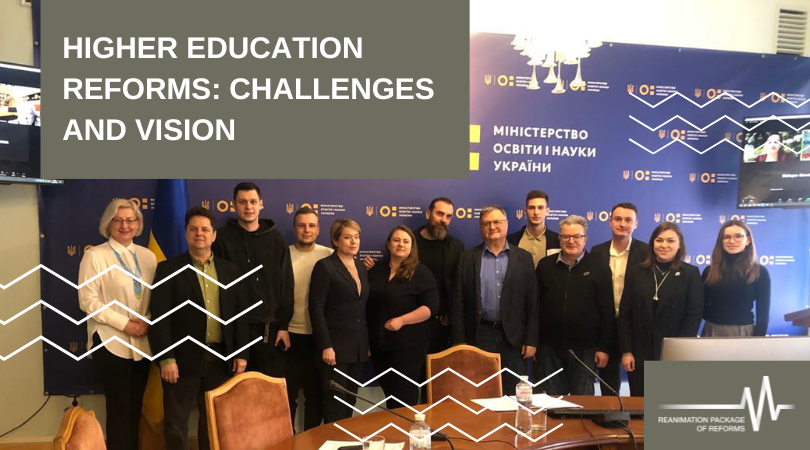
Yesterday, Minister of Education and Science Oksen Lisovyi, Deputy Minister Mykhailo Vynnytskyi, MP Roman Hryshchuk, Executive Director of the RPR Coalition Olga Lymar, former Minister of Education and Science Liliia Hrynevych, Professor Yevhen Bystrytskyi and other civil society experts gathered at the roundtable.
The meeting was held on the basis of the policy document “Vision of Ukraine 2030: Social and Humanitarian Sphere”, created by the Reanimation Package of Reforms Coalition together with the School of Political Analysis, Prof. Yevhen Bystrytskyi and 50 independent civil society experts with the donor support of PACT/USAID. The project was presented by Prof. Volodymyr Bakhrushyn, head of the expert group consisting of: Yulia Bezvershenko, Mykhailo Vynnytskyi (at the 1st stage), Prof. Oleksiy Kolezhuk, Ihor Koliushko (1st stage), Svitlana Oleksiuk, Oleksiy Panych, Halyna Tytysh, Liliia Hrynevych (at the 2nd stage), Natalia Shulga (2nd stage) and group manager Danylo Metelskyi.
“There is a lack of such a development as a vision for reforming the Ukrainian state at all levels. All changes should be based on this vision, which should be discussed, debated, and constantly updated. The more dialogue there is between the ministry and civil society, the more mature the policies that are implemented will be. We have to work with the cultural dimension. We must transform the closed system of higher education, which is based on Soviet practices,” – the minister assured.
We presented our vision of higher education reform to the government officials, discussed the problems and ways to solve them.
“We see the task of our project as supporting the fruitful efforts of the ministry and making the reform process more inclusive for the public, i.e., recognized as necessary and required by the majority of society. And this can only be achieved through an effective, critical and self-critical dialog between independent civic experts and responsible representatives of the Ministry and the Verkhovna Rada. This is exactly what happened today at the advocacy meeting,” – says Yevhen Bystrytskyi about the “Vision of Ukraine 2030”.
As a result, the participants agreed on cooperation, the need to involve the public in shaping and discussing legislative changes and developing a common vision and promoting the reform. Olga Lymar summarized: “Civil society organizations are ready to help the state promote an important and difficult reform, to provide expert and communication assistance. I am grateful to the Ministry for its willingness to engage in dialogue. I am glad to see that many common ideas are already in the process of being developed into concrete solutions”.


