Reanimation package of reforms > News > Analytics > Not just elections, not just grain: How Ukraine and Poland can avoid a major crisis in relations
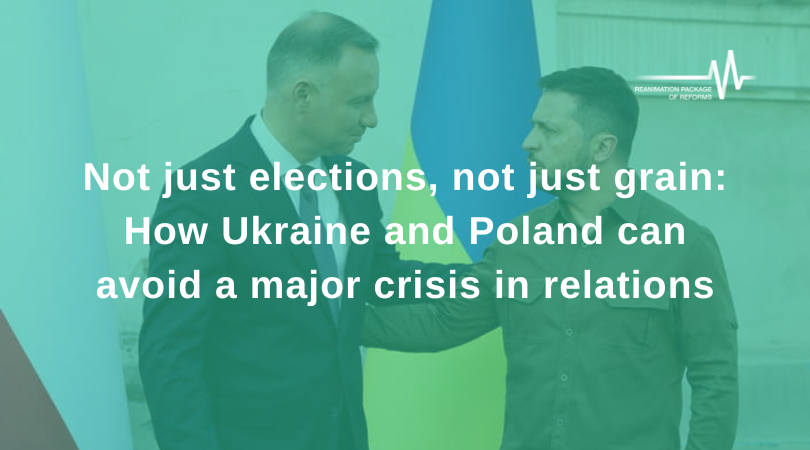
In recent days, tensions between Warsaw and Kyiv have been growing. Many people, especially in Ukraine, attribute this to the active election campaign that has de facto already begun in Poland. Likewise, Warsaw’s plans to extend the ban on imports of Ukrainian grain are also often associated with Polish politicians’ competition for the electorate.
The upcoming elections in autumn may impact the decision, but it would be a mistake to narrow the causes of these tensions to the election campaign alone. Instead, a timely analysis of what is currently a tactical misunderstanding will lower the temperature in the dialogue with Warsaw and minimize such risks in the future.
Maria Zolkina, Head of Regional Security and Conflict Studies and a researcher at the London School of Economics and Political Science, wrote about this in an article for Yevropeiska Pravda.
Although problems and misunderstandings in relations between the two capitals had been building up for some time, the publicly visible part of this escalation was triggered by a statement by a representative of the Polish presidential administration about the need for “greater gratitude” on the part of Ukrainians for the assistance from his country.
These words initiated an exchange of harsh statements and actions that quickly led to a near-crisis in bilateral relations.
At first, Marcin Przychod’s colleague in the Office of the President of Ukraine, Andriy Sybiga, reacted to his counterpart’s words in a lengthy and public manner, and in some ways even harshly. For example, he resorted to analogies that “some politicians are becoming a ‘tool’ of the Russian aggressor.” And Kyiv did not limit itself to words. Immediately afterward, the Polish ambassador was summoned to the Ukrainian Foreign Ministry, followed by a mirror image move by the Polish Foreign Ministry and criticism of the Ukrainian side’s actions by the Polish Prime Minister.
However, the motivation of Warsaw and Kyiv and the extent to which the actions of both sides were adequate should be examined in more detail.
First, Przychod’s statement about the “lack of gratitude” was not general but had a precise context. With these words, he described the old views and demarches of the Ukrainian side, which tried to influence the Polish government and convince it not to impose a new ban on Ukrainian grain exports.
In the spring, we already had a full-scale crisis that went beyond Ukrainian-Polish relations but started precisely because of Warsaw’s decision. Back then, the Polish government unilaterally closed the borders for several Ukrainian agricultural exports to its territory. This blockade, imposed in violation of EU rules, destroyed the standard European rules of foreign trade and triggered a domino effect in other Eastern European countries.
After lengthy negotiations, a compromise was reached – the European Commission duplicated the ban in a slightly modified form. This unblocked grain transit via Polish and other routes outside the EU and to other EU countries that do not border Ukraine.
By agreement, the protection scheme was temporary, and its validity is due to expire on 15 September, as officials in Brussels have repeatedly promised. Meanwhile, in July, Warsaw announced it would reintroduce a unilateral ban on 15 September. This, along with fears of a new “domino effect,” was the primary source of Kyiv’s irritated statements, to which Przydacz later responded.
After all, following Russia’s withdrawal from the so-called “grain deal” and the targeted destruction of Ukrainian ports, the land route of exports has become the only alternative.
However, nervousness should not justify the simplifications in Kyiv’s rhetoric.
For example, the fact that restrictions on imports of Ukrainian grain are currently in place for only five EU countries is almost absent from the domestic discussion, meaning that it is incorrect to talk about a “ban on exports to the EU.” Just as there are no bans on Ukrainian grain transit through Poland.
In any case, the radical statement by the Ukrainian Prime Minister that Poland was blocking exports to the EU was also perceived in Poland emotionally – as a twitch and manipulation. So, this communication exacerbated Kyiv’s nervousness with Warsaw, eventually resulting in Przychod’s statement.
It is also essential to add here that it is not only Poland that is in favor of extending the import ban – in July, but the governments of all five countries currently subject to restrictions (Poland, Slovakia, Hungary, Romania, and Bulgaria) also signed a declaration of intent to support the extension of the EU ban after 15 September. However, no one else has spoken out as sharply as Poland, promising a unilateral ban if the EU does not have the votes for a general prohibition.
Poland, in general, and Polish diplomacy have always paid special attention to gestures and symbolism. And Ukraine has not taken this into account.
If the dispute between the parties concerns only the mechanisms of export or transit of agricultural products, was the summons of the Polish ambassador to the Ukrainian Foreign Ministry proportionate to Przychod’s statement?
It is also essential when it happens.
It happened on 1 August, one of the critical dates for Poles – the Day of Remembrance of the Warsaw Uprising of 1944, when mass events were held throughout Poland to commemorate the victims.
It is difficult to overestimate the importance and symbolism of historical events for Poles.
But, unfortunately, this is not the first precedent when the timing of Kyiv’s actions is, to put it mildly, unsuccessful. Warsaw, in particular, has not yet forgotten the maneuvers around sensitive issues of historical memory that overshadowed the Polish president’s visit and speech to the Verkhovna Rada in 2015. As a result, these diplomatic steps caused great resonance in both Ukraine and Poland.
It is also important to emphasize that the grain dispute with Poland in Ukraine is associated with an active election campaign. Indeed, the autumn elections are the first since 2015 that the current ruling party, Law and Justice, will likely lose.
But there is one caveat.
Several political nuances in relations between Ukraine and Poland are worth paying attention to. For Warsaw, they are essential markers of ties with Ukraine and create a context that is much broader than pre-election populism.
And this context is not in favor of Ukraine.
Poland has been and remains one of the critical drivers of support for Ukraine, from armed and political support to providing shelter to Ukrainians fleeing the war.
But this does not mean that all Polish actions should align with Ukrainian needs. And no matter how close our relations are, it is naive to believe that Poland’s unconditional support for Ukraine will continue indefinitely.
Strategic partnership and alliance for the long term are pretty realistic.
But it must be bilateral. It requires prudent diplomacy, coordination of common interests, and joint defense in the international arena.
This is not always the case between Kyiv and Warsaw.
While the Ukrainian side is outraged by the politicization of the grain issue in Poland, the Polish side also has questions about Kyiv’s actions. So far, they are mostly voiced off the record, but that’s all the better for us: there is still an opportunity to prevent these concerns from turning into real problems.
Yes, Poland is extremely sensitive to any manifestations of external political pressure. And if Ukraine sees Poland as its strategic partner, this should be considered in public communication.
Poland also has questions about Ukraine’s consideration of its security interests.
An example is the story of the so-called “security guarantees.” On the sidelines of the NATO summit in Vilnius, Ukraine managed to get the G7 political declaration on the format of security agreements approved, and this seems like a good start for Kyiv. But Warsaw remains to be clarified: Where does Poland fit into this process? Poland is not a member of the G7, but what prevented Ukraine from coordinating these actions with its most prominent Western neighbor? Especially given that the Poles and Lithuanians were the critical lobbyists for Ukraine’s invitation to NATO in Vilnius and before it…
It is not for nothing that Poland is still not on the list of countries that have signed the statement on “guarantees.”
And this is not the only episode.
It also seemed strange to the Polish side that its representatives did not attend the meeting in Copenhagen to promote Ukraine’s “peace formula.”
Warsaw is reminded of the sad experience of relations with Ukraine before the Great War.
It fears that instead of building solid regional alliances based on common security challenges, Ukraine is relying on the great powers of the “old West” – as it did in 2014-2022, including the Normandy format.
Political and expert circles in Poland remember that the 2020 National Security Strategy states that Ukraine’s “strategic priority” is relations with the United States, Britain, Canada, Germany, and France, while ties with Poland are of a lower rank.
And given recent trends, the author of these lines has heard her Polish colleagues express concern off the record: that the president of Ukraine, on the one hand, is receiving political dividends from Poland’s comprehensive assistance and mediation, but that in global issues he is gradually drifting towards old alliances.
A question usually follows this:
Does Ukraine see Poland as a situational partner that will support it by default because of the threat from Russia? Or is it a strategic partner with an appropriate long-term policy towards Warsaw?
So, there is a need for more active coordination and a more balanced dialogue.
Timely and systematic work on a genuinely strategic alliance helps offset the current misunderstandings.
After all, Warsaw knows its role as Ukraine’s logistical and diplomatic rear. Still, it is not unreasonable to believe that without Poland’s full involvement, no security guarantees for Ukraine will be possible.
This does not mean that Warsaw will cynically “trade” its significant resources, at least logistically. But it does mean that Warsaw will not accept decisions made between Ukraine and the conventional “big players” that will be communicated to Poland.
Just as the principle of “nothing about Ukraine without Ukraine” is essential to us, it is critically important for the Poles to have “nothing about Poland without Poland.”
Ukraine also needs to realize that as the full-scale war progresses, our partners are no longer ready to respond as sharply as they used to Ukraine’s military and economic needs. The discussion is becoming more challenging and more down-to-earth.
And this may be the case with our closest friends in Warsaw.
That is why caution and a reduction in tension on both sides are more than appropriate. Much broader issues are at stake than the impact of the Polish elections on Ukrainian grain exports. No matter how important it is for the survival of the Ukrainian economy.
Read more on the website of Yevropeiska Pravda.


