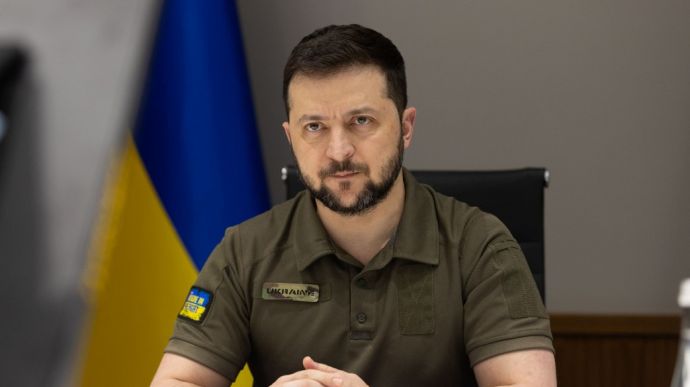
Until recently, you’d have been hard-pressed to believe that Volodymyr Zelenskyy would be the one to lead Ukraine’s struggle against a raging war imposed by Russia. A few years ago, he didn’t even have anything to do with politics. Today, he’s the sixth president of an independent Ukraine—and suddenly one of the most extraordinary political leaders of our time. Call it irony or fate, but the man who once portrayed himself as an ordinary man on-screen fighting the odds to become the valiant leader of his nation is now living this narrative as his reality.
So what made him stand out? What events have underpinned his extraordinary rise to the global stage? Is he truly the untapped underdog we never saw coming, or are we simply living in an age of unconventional political upheaval? Why is Volodymyr Zelenskyy the most unconventional man of 2022?
For a start, every step leading up to Zelenskyy’s political biography has been unique. The youngest Ukrainian president in history, he took office in May 2019 at merely 41 years old— a distinct achievement when compared to an American president’s median age being 55 [or above]. Volodymyr’s family members have been no strangers to war or its impacts; his great-grandparents were killed by German troops during World War II, alongside his grandfather’s three brothers. Born in 1978 to Jewish parents— a computer scientist father and an engineer mother—Zelenskyy grew up in an academic household. A sharp student, he learned Russian and had passed his English Foreign Language test by the time he was 16. Having received an educational grant, he had the opportunity to study abroad in Israel, but gave it up as his father didn’t allow him to go. Zelenskyy then studied to become a lawyer [qualifying at the Kryvyi Rih Institute of Economics, now known as Kryvyi Rih National University], though he never ended up working as one. As is often the case in Ukraine, he chose his education simply based on the expectation of his parents.
At 17, Volodymyr joined KVN [a comedy tournament that was popular in the Soviet Union and later, in some post-Soviet countries; now it does not exist in Ukraine] and began competing in major league competitions, eventually winning one in 1997. A creative with a natural leadership streak, he set up and hosted student entertainment concerts and other live shows, and in 2003 became one of the founders and artistic directors of the comedy studio Quarter-95 [Kvartal-95] in Kyiv. There, he produced witty and provocative content for the Ukrainian audience, underpinned by a core message of spreading kindness amongst his local communities.
By the early 2000s, Volodymyr had become one of the most recognisable comedians in Ukraine [and oddly enough in Russia]. Successfully transforming his comedy show into an entire entertainment industry, he created a studio to shoot movies, produce shows of various formats and host thousands of concerts worldwide. In 2008, he starred in his first feature film Love in the Big City; a romantic comedy about two friends living in New York and exploring a life of indulgence and no-strings-attached fun. The movie was a commercial success, resulting in two consequent sequels in 2010 and 2014, the former starring Zelenskyy. Alongside his feature film career, he assumed another role on a much larger stage—a national one. From 2010 to 2012, he was on the board of one of Ukraine’s most significant television networks, Inter, becoming the general producer of a show that reached over 99 percent of the country’s population [source: Kyiv Post, 2013]. As his career grew, it became more and more difficult to deny Zelenskyy’s unique creative prowess and knack for catchy topics. He’d somehow found the ultimate balance between creativity, compassion and comedy—and murmurs emerged that a new star was born.
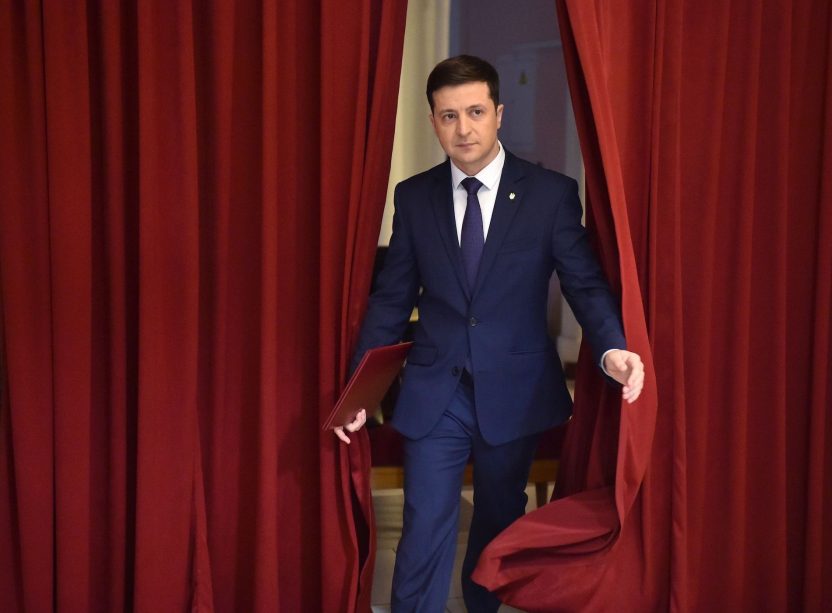
To truly understand the next chapter of Zelenskyy’s career, is to recognise that no emergence of a political leader is ever complete without the historical context which enables their foundation. The same applies to Volodymyr, no matter how unconventional his surge to power may seem.
Since the fall of the Iron Curtain in 1989, present- day Russia has never hidden its large-scale ambitions to recapture Ukraine [which declared independence in 1991]. The desire to relive its heyday of pre-wartime glory remains one of the key factors for the power- hungry efforts of the invasion we see today. Some political experts have posed the question: Why wouldn’t Russia feel so inclined when, over recent years, billions of petrodollars have flowed into Ukraine through the hands of corroborating politicians willing to place their impulses for wealth above the sanctity of strengthening state institutions? And will European countries [where Russia has spent billions of dollars on its own propaganda] close their eyes to these unprecedent violations of international law, and stand by as a war unleashes in the centre of Europe?
A simple search through history will tell us otherwise, when it comes to Ukraine’s intent to ever belong under Russia’s governance or rule. Tracing back to between the ninth and twelfth centuries, Ukraine was founded in the roots of the ancient state Rus; and Ukrainian princes, in fact, were paramountly influential in the discovery and foundation of Moscow as we know it today. For centuries, Ukraine has cultivated its own culture, language, traditions, heritage and stories— fighting for independence and seeking sovereignty from its Russian counterparts in every way.
In November 2013, the Revolution of Dignity began with Ukrainians demanding for authorities to sign an Association Agreement with the European Union— a powerful step towards Ukraine potentially solidifying its integration into the European Union. What started as a bid to cement the path on its European course, ended with the shooting of civilians in the heart of Ukraine. This event was a turning point in the state’s history. Corrupt and driven by pro-Russian sentiment, President Viktor Yanukovych fled to Russia
to escape public pressure, leaving behind weakened state institutions, and paving the way for opponents to occupy Ukraine’s territories near the border. In response to the unfolding conflict, Ukraine set course to implement reforms to lessen corruption, prop up state institutions, develop more effective ruling procedures, and began to focus on how to develop a truly democratic state. One where the rule of law prevailed and everyone could live with dignity, privy to the same rules and consequences.
Flash forward to today, within eight years [in spite of endless criticism and ongoing disputes by experts on whether they should’ve done more or less] Ukraine has made substantial progress—climbing from the world’s 144th place to the 122nd in the Transparency International Corruption Perceptions Index. An admirable feat for a country so torn apart previously by fragmented governance.
As the Revolution of Dignity—the occupation of Crimea and parts of the Donetsk and Luhansk regions by Russia—continued to unfold in 2014, Volodymyr Zelenskyy discovered a newfound opportunity to hold politicians in Ukraine accountable through his comedy. Where at one time he would give no more than a cursory glance of entertainment value at political issues, Zelenskyy found himself undergoing a tectonic shift in perspective. His comedy began drawing light on major political issues, the failings of those involved in them and the consequences of the apathy in resolving them. Where previously light-hearted, his performances began to carry a much more serious undertone—in particular of the effects of conflict on the future of Ukraine, and the plight of its people. On one such occasion, he rearranged the lyrics of a popular Soviet song about separation in the war. The lyrics “Don’t say goodbye to the one you love” were changed to “Don’t separate from the one you love”. The rewritten words told of the pain of the occupation of Crimea and the disbelief surrounding it, with the song ending by reiterating a message of hope for the reclamation of land back to its rightful owner, Ukraine. The sombre tone of this lyrical change represented an atypical shift for Zelenskyy’s otherwise carefree and laughter-inducing show, signalling the catalyst for what was to come next in his career.
Now, if one had to pinpoint the climacteric moments in Zelenskyy’s transition from career-actor and comedian to global politician, the TV series Servant of the People emerges top of the list. Starting its run in November 2015, the show tells the story of a largely naive and ordinary history teacher from a Ukrainian village, who’s fed up of failing, corrupt politicians and runs for presidency. To his shock, he wins. Zelenskyy’s character and the protagonist of the show (Vasyl Holoborodko) is portrayed as a simple working-class man, connected to the everyday problems of the ordinary people. As the show depicts, his unprecedented win comes down to his ability to call things out by their name— unabashedly and without fear of retaliation for what others may think. The show was an instant hit—winning the WorldFest Remi Award [USA, 2016] and being amongst the top four finalists for the comedy category at the Seoul International Drama Awards in South Korea. It has also been reinstated to the line-up of trending series on Netflix, in spite of its original run ending in March 2019.
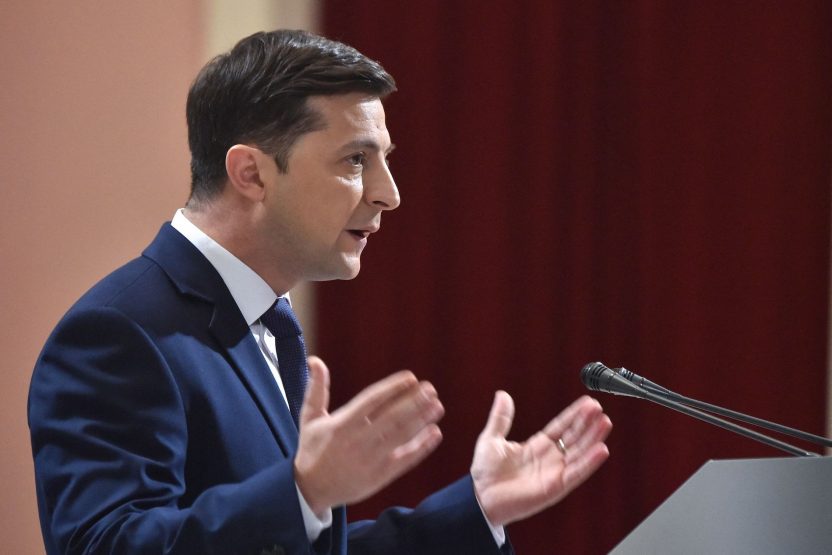
It’s perhaps here, that we can draw the most parallels to the unconventionality of Zelenskyy’s background with his present- day circumstance.
In March 2018, Zelenskyy’s colleagues saw his political potential and registered a new political party under the name of the show. Though initially denying any plans to enter politics, in April 2019, driven by public sentiment and a desire to break the systemic corruption in Ukraine, Zelenskyy emerged as the unforeseen candidate during a critical election period. Campaigning on the merits of his relatability and promise of representing the everyday person, he ran the majority of his campaign virtually [against usual political procedures]. Zelenskyy’s appeal was one of the anti-establishment hero, seeking to upheave outdated customs of political management and bring about modernised change.
Throughout his campaign run, Zelenskyy continued to perform several comedy and stand-up routines, even vowing to take steps in resolving Ukraine’s prolonged conflict with Russia and engage in dialogue with Vladimir Putin during such shows. In May 2019, with reality once again mirroring his celluloid characterisation, jaded Ukrainians—fed up by the broken promises of regimes past and desperate for a chance at peace—voted in Volodymyr Zelenskyy as their next president with 73 percent of the vote [in accordance to Ukrainian media sources]. His win not only marked a historic landslide in the nation’s history, but also became the envy of many of his local and global democratic counterparts. So unconventional was Zelenskyy’s rise, that opponents accused him of cutting corners and using unprofessional tactics openly, as a way to justify their own losses.
Through the chaos and accusations, Zelenskyy’s initial days in office reiterated his perseverance to unite the country. He began tapping into different regions of Ukraine and using social media to address varying stratas of society. His team made incredible efforts prior to and after the election, to activate the normally passive youth and engage them in the country’s political landscape. Through diversifying their communication methods, they opened a dialogue with millennials and Gen Zs, collecting insight and feedback on their wants and needs from a modern Ukraine. It was an unusual but successful tactic—being so close to the ground. In lieu of professionally shot studio images taken for his campaigns across media channels, Zelenskyy opted for self-shot selfies on the streets of Ukraine, surrounded by his supporters. In spite of these efforts, many amongst the political aristocracies continued to ask, “Who did we really vote for—Zelenskyy or Holoborodko?” Which begged the question: Was Zelenskyy’s capability for the role built on the foundations of his real personality, or that of a naive representation portrayed by a well- meaning character meant only to be enjoyed on-screen?
Facets such as the denial of rules, attempts to do things differently and govern the country in a more contemporary way, have characterised Zelenskyy from the first days of his political struggle for the presidency—and still do. In 2019, whilst appearing on a popular television show in a video published on social media, he publicly challenged his predecessor and Ukraine’s fifth president Petro Poroshenko, into taking part in a political debate. It was to be held at a stadium in central Kyiv. Brazen, Zelenskyy’s provocation turned an otherwise politically-familiar process into a showstopping moment for his constituents to witness first-hand in a crowd, instead of as a pre-filmed television show. The move went viral across social networks [exactly as Zelenskyy had wanted], drawing the attention of large crowds and journalists worldwide. His opponent’s response “So the stadium it is” has now become a long-running meme amongst Ukrainians. But Zelenskyy’s unconventional approach to politics didn’t stop there. Immediately after winning the election, in his inaugural speech at the Ukrainian Parliament, he spoke of his plans for a dissolution, launching the procedure for parliamentary elections into an early spin. Success in the presidential election guaranteed the success of his party, which he had aptly named after his famous show [Servant of the People]. Zelenskyy’s party received more than 43 percent of the parliamentary vote [in accordance with official polling statistics published in the Ukrainian media], allowing them to form a one-party coalition without disruption. Through their vote, the Ukrainian public once again, showed their unprecedented support for Zelenskyy and his political agenda; surprising not just his opponents, but also watchers of his rise worldwide.
Where other presidents have weaved and bobbed behind the protections of bureaucracy and the safety net it offers, Zelenskyy has emerged as a strong adversary. Pushing for simplicity in political processes and to establish a more modern and business- like government, he renamed the Presidential Administration as the Office of the President (OP), willing to relinquish state security and moving the OP into a more minimalistic and less pretentious building. His first major press conference since taking office lasted 14 hours, breaking the record for hosting the longest press conference in history. Its location, too, was unconventional to say the least—a renovated food court, which has since become a favourite location amongst the citizens of Kyiv. As the day progressed, journalists came and left, with approximately 300 accredited journalists attending. Zelenskyy spoke with them all, continuing to answer question after question, no matter how uncomfortable.
At every step, his career began to parallel that of his character’s—a simple man with a simple mission to do hard things for the good of the people. In a now-unforgettable moment during his inaugural speech, Zelenskyy famously said, “Each of us is the president.” Though many laughed, others heeded it as a sign of the times to come.
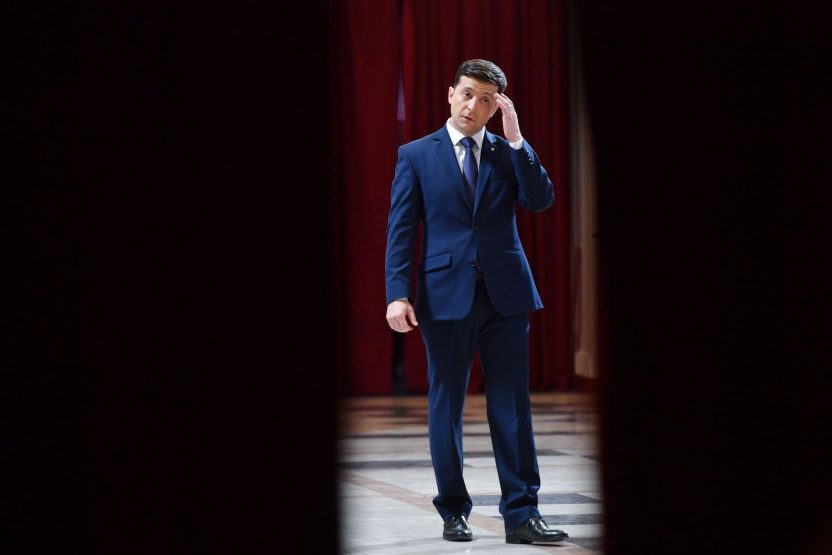
For all his praise, Zelenskyy has also faced his share of criticism on his journey to the top. For one, upon taking office, he and his team had a completely different approach when it came to working with non-governmental organisations (NGOs) and think tanks. At the outset, there appeared to be a struggle in understanding their existence and how best to partner with them to drive communication and policy reform. If one can use social media to garner feedback and real-time insights from people, then why listen to professional experts who often come up with their own agenda? Zelenskyy’s approach has also often been labelled as too hasty and not always well thought-out when it comes to policy decision-making. He’s been criticised for operating on ‘turbo- mode’ on more than one occasion, especially when it’s about the passing of laws in Parliament. Some have even said he has a tendency to pass policies faster than they can be published. With maturity and time, Zelenskyy has now begun extending the hand of partnership to advisers, NGOs and think tanks, starting to listen to recommendations and reservations. This effort, no matter how strained, has been impactful and representative of the first signs of positive change in mindful governance.
Since taking office, Zelenskyy’s ratings have also fluctuated— so much so, that many have speculated as to whether or not this fact influenced Russia to invade when it did. Perhaps their intelligence decided that variable polling numbers held a correlation between the Ukrainian society’s dissatisfaction with their political establishments, and their willingness to accept the Russian invaders with open arms. However, one need not look too far to know what is missing from this logic; which is the inability of any analytical report to draw light on just how passionately Ukrainians can unite against a common enemy when it comes to state sovereignty. Ukrainians are undoubtedly harsh critics. But their willingness to pay with blood for changes to the state, for democratic elections [even when a large part of society is dissatisfied with them], to read the independent press, to have access to medicine and education, to speak their language and to study their history, is often undermined. Political debates in Ukraine may be fierce, but none have ever been existential in nature, or divisive about Ukraine’s rights to exist and fight for its independence.
On the eve of 1 January 2022, President Zelenskyy made a speech that brought tears to thousands of Ukrainian families listening. He spoke of Crimea, the Donetsk and Luhansk regions, and the heartache of their current occupation by Russian territories. He discussed the value and power of the Ukrainian army. Many were surprised at Zelenskyy’s speech. His rhetoric had suddenly moved from that of a simple man with a desire to be close to his people, to one recounting and preparing Ukraine for a new world order. Few in the country wanted to believe that Russia would escalate its ambitions into a full-scale bombing of one of the largest states in Europe, and Zelenskyy’s words were an uncomfortable reminder of what was possible.
On 19 February, Volodymyr made another historic speech, this time at the Munich Security Conference. The moment for subtlety was over. “This is your contribution to the security of Europe and the world, where Ukraine has been a reliable shield for eight years,” Zelenskyy said. In a jarring message to his global counterparts [namely the West], he emphasised Ukraine’s voluntarily renunciation of nuclear weapons in exchange for security and territorial integrity.
As of 24 February, a new dawn has arisen for President Zelenskyy. Decision-making haste aside, his charisma is undeniable, as is his unique ability to unite his people. Since the commencement of the full-scale invasion, he’s been present and unafraid to be on the ground, walking openly amongst his constituents [those who have yet to flee and remain], addressing them daily and reassuring them of his commitment to the cause. He’s met with countless leaders and parliaments of countries worldwide, while having a thousand missiles and sirens volleying above him. In spite of the threat of ongoing air strikes, he recorded his public address on the first night of the war from his office in Kyiv, and has continued to record many others from the street near the OP. He immediately dispelled any and all fake rumours by Russian opponents citing his fleeing and abandonment of the country, instead reiterating to every Ukrainian that their president would fight to win the war, side-by-side with its army and its people.
Part of his unique ongoing appeal is his penchant for logic and reason. Zelenskyy has stated on several occasions that whilst he has the desire to protect and fight for Ukraine’s independence, his is not closed off to the notion of negotiations. His level-headedness and patience for diplomacy have incited dozens of European leaders to visit Kyiv recently. They include British Prime Minister Boris Johnson, European Commission President Ursula von der Leyen, Polish President Andrzej Duda, Lithuanian President Gitanas Nausėda, Latvian President Egils Levits and Estonian President Alar Karis; alongside members of the European Parliament such as speakers, senators, as well as prime ministers from other countries. The resounding effect of these visits, is the first-hand awareness and witnessing on a global scale of the campaign of genocide against Ukrainians, happening en masse. The casualties in Bucha and Irpin on the outskirts of Kyiv are only two such examples. Even at the risk of their own lives and the impending threat of a missile strike, global leaders have descended upon the country’s shores to rally support for Ukrainians, and shake hands with Volodymyr Zelenskyy— the President who has undoubtedly set a worthy example for leadership worldwide.
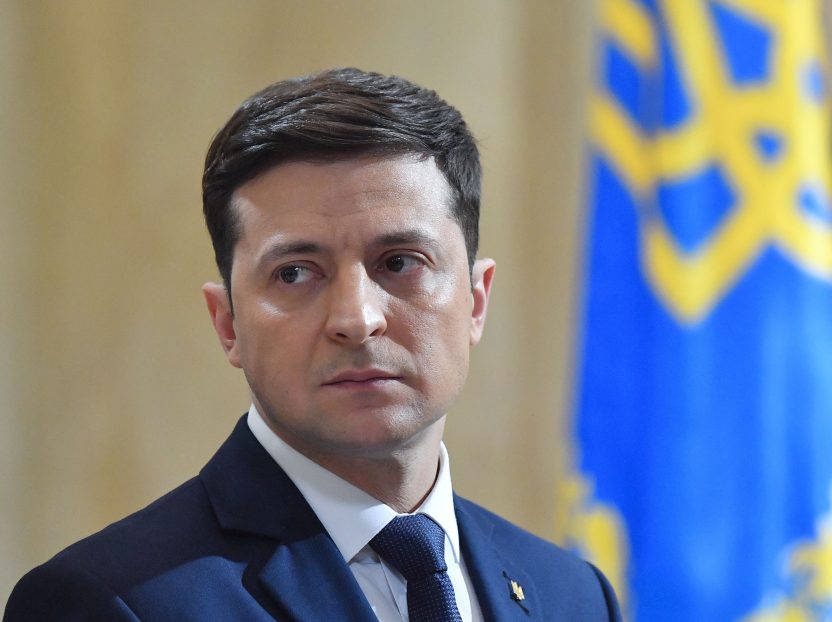
Perhaps it’s too early to give a final assessment of Zelenskyy today and the long-term efficacy of his policies. It’s difficult to predict exactly how he will be remembered in history, but undeniably he will be an integral part of it. Ukrainians in recent national polls have indicated that 93 percent of them do believe that they will win the war and come out independently [according to sources in the Ukrainian media]. Even after the war may be long gone and over, however, the discussion on how to develop Ukraine is one that will still remain.
But what we can say for sure, is that Zelenskyy, in all his unconventional light, has cast the darkest shadows over the evil that has unfolded in Ukraine. With his boldness, courage and unnerving resiliency, he has unconventionally yet truly emerged as a servant of his people.


